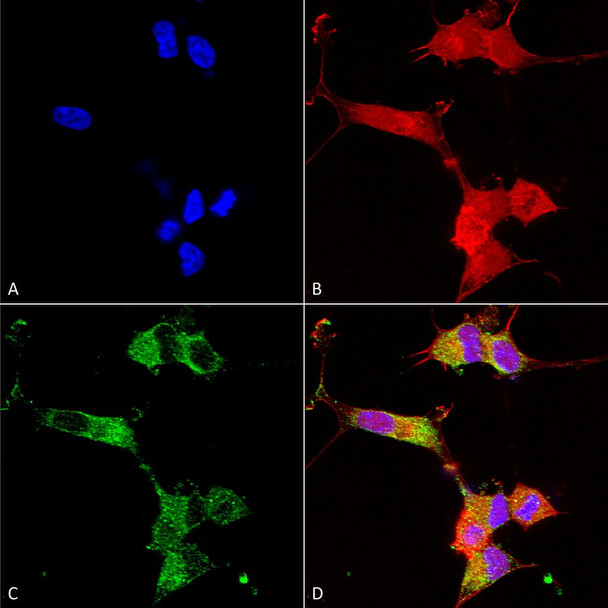
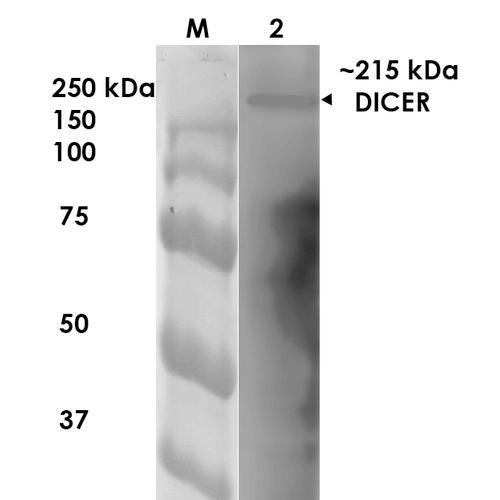
NALCN Antibody [N187/7 (Formerly sold as S187-7)] is a mouse monoclonal antibody directed against NALCN, offered by Assay Genie for research applications. Reported applications include WB and ICC/IF. Reported reactivity: Human, Mouse and Rat. Supplied as IgG1, purified by Protein G.
NALCN (sodium leak channel non-selective protein), also known as CanIon or VGCNL1, is a voltage-independent, nonselective cation channel that plays a critical role in maintaining neuronal excitability. Widely expressed in the central nervous system and highly conserved across mammals, NALCN contributes to the background sodium leak conductance in neurons, regulating resting membrane potential and spontaneous firing. Activated by neuropeptides such as substance P via the NK-1 receptor, NALCN is permeable to sodium, potassium, and calcium ions. Its function is essential for respiratory rhythm generation, as evidenced by knockout mouse models that exhibit disrupted breathing and neonatal lethality. Dysregulation of NALCN has been implicated in neurodevelopmental disorders, epilepsy, and neurodegenerative conditions where altered excitability and ion homeostasis are central features. Given its role in basal neuronal activity and survival, NALCN represents a promising target for therapeutic intervention in diseases characterized by impaired excitability and synaptic dysfunction. This antibody is also available conjugated to ATTO 390, ATTO 488, ATTO 594, APC, Biotin, FITC, HRP, PerCP and RPE. Supplied in 100 µg. For research use only; not for diagnostic or therapeutic procedures.
Store at -20°C. Shipped on Blue Ice or 4°C. Conjugated variants should be stored according to the product label.
Format:
Liquid
Applications:
WB, ICC/IF
Antibody Isotype:
IgG1
Purification:
Protein G Purified
Concentration:
1 mg/ml
Reactivity:
Human, Mouse, Rat
Recommended Dilution:
WB (1:1000), ICC/IF (1:100); optimal dilutions for assays should be determined by the user.
Specificity:
Detects ~200kDa.
Guarantee:
12 months from date of dispatch
Immunogen:
Fusion protein amino acids 1659-1738 (cytoplasmic C-terminus) of rat NALCN
Immunogen Species:
Rat
Accession Number:
NP_705894.1
Gene ID:
2630-05-12 00:00:00
Swiss-Prot:
Q6Q760
Cellular Localization:
Membrane
Alternative Names:
NALCN, VGCNL1, CanIon, Sodium leak channel non-selective protein, Voltage gated channel-like protein 1, A530023G15Rik, bA430M15.1, FLJ23913, FLJ44659, FLJ44764, Four repeat voltage gated ion channel, MGC74524, Putative 4 repeat voltage gated ion channel
References:
1. Lee, J.H., Cribbs, L.L. and Perez-Reyes, E. (1999)FEBS Lett. 445: 231-236. 2. Lu, B., Su, Y., Das, S., Liu, J., Xia, J. and Ren, D. (2007) Cell 129: 371-383. 3. Jospin, M., et al. (2007) Curr. Biol. 17: 1595-1600. 4. Gaultier, C. and Gallego, J. (2008) Appl. Physiol. 104: 1522-1530. 5. Yeh, E., et al. (2008) PLoS Biol. 6: e55.