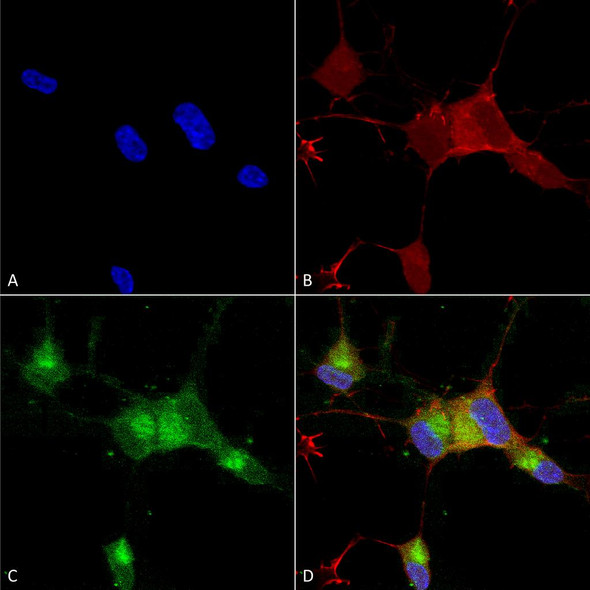
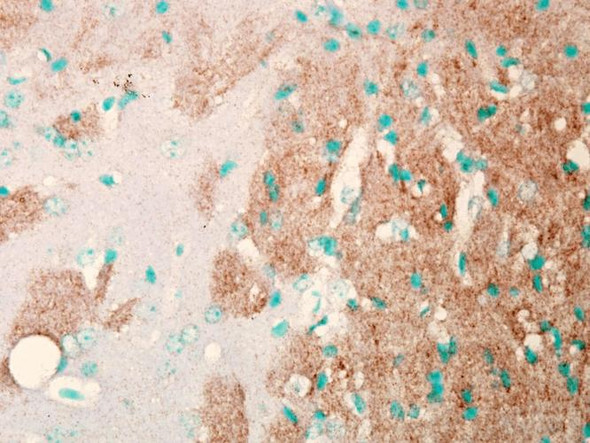
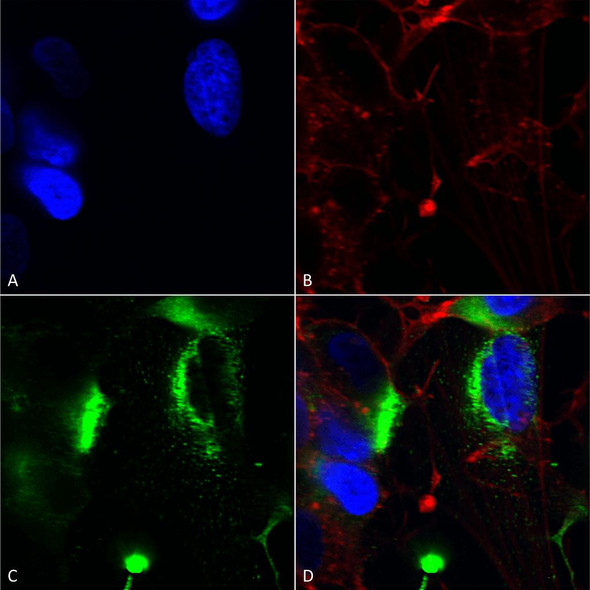
KCNQ4 Antibody [N43/6 (Formerly sold as S43-6)] is a mouse monoclonal antibody directed against KCNQ4, offered by Assay Genie for research applications. Reported applications include WB, IHC, ICC/IF and AM. Reported reactivity: Human, Mouse and Rat. Supplied as IgG1, purified by Protein G.
KCNQ4 encodes a voltage-gated potassium channel subunit that plays a vital role in regulating neuronal excitability, particularly in sensory systems. Predominantly expressed in the outer hair cells of the cochlea, KCNQ4 contributes to potassium ion efflux, maintaining the resting membrane potential and enabling precise auditory signal transduction. This channel is modulated by key signaling pathways: it is inhibited by M1 muscarinic acetylcholine receptors and activated by retigabine, a potassium channel opener with anticonvulsant properties. These regulatory mechanisms highlight KCNQ4’s importance in maintaining excitatory-inhibitory balance in neurons. Mutations or dysfunction in KCNQ4 are strongly associated with progressive sensorineural hearing loss (DFNA2), but emerging evidence suggests broader implications in neurodegenerative disease. Disrupted potassium channel activity can lead to chronic neuronal hyperexcitability, oxidative stress, and eventual neurodegeneration—mechanisms shared across conditions such as Alzheimer’s disease, epilepsy, and age-related hearing loss. Given its pharmacological responsiveness and role in sensory neuron stability, KCNQ4 is gaining attention as a potential therapeutic target. Enhancing its function may offer neuroprotective benefits by restoring ionic homeostasis and preventing excitotoxic damage in vulnerable neural circuits. As research into ion channelopathies expands, KCNQ4 stands out as a key player in both auditory neuroscience and the broader landscape of neurodegenerative disease research. This antibody is also available conjugated to ATTO 390, ATTO 488, ATTO 594, APC, Biotin, FITC, HRP, PerCP and RPE. Supplied in 100 µg. For research use only; not for diagnostic or therapeutic procedures.
Product Name:
KCNQ4 Antibody [N43/6 (Formerly sold as S43-6)]
Product SKU:
STMA00086
Size:
100 µg
Target:
KCNQ4
Host Species:
Mouse
Antibody Type:
Monoclonal
Clone ID:
N43/6 (Formerly sold as S43-6)
Research Areas:
Neuroscience, Ion Channels, Potassium Channels, Voltage-Gated Potassium Channels, Cancer
Buffer:
PBS pH7.4, 50% glycerol, 0.09% sodium azide
Storage & Shipping:
Store at -20°C. Shipped on Blue Ice or 4°C. Conjugated variants should be stored according to the product label.
Format:
Liquid
Applications:
WB, IHC, ICC/IF, AM
Antibody Isotype:
IgG1
Purification:
Protein G Purified
Concentration:
1 mg/ml
Reactivity:
Human, Mouse, Rat
Recommended Dilution:
WB (1:1000), IHC (1:1000), ICC/IF (1:100); optimal dilutions for assays should be determined by the user.
Specificity:
Detects ~77kDa.
Guarantee:
12 months from date of dispatch
Immunogen:
Fusion protein amino acids 2-77 of human KCNQ4
Immunogen Species:
Human
Accession Number:
NP_004691.2
Gene ID:
1924-12-31 00:00:00
Swiss-Prot:
P56696
Cellular Localization:
Plasma Membrane | Basal Cell Membrane
Alternative Names:
KCNQ4, Kv7.4, KVLQT4, Potassium voltage-gated channel subfamily KQT member 4, Voltage-gated potassium channel subunit Kv7.4, KQT-like 4, Potassium channel subunit alpha KvLQT4, Potassium voltage-gated channel KQT-like subfamily member 4, DFNA2, KCNQ4_HUMAN, Kcnq4, KCNQ 4, Potassium channel KQT like 4, Potassium voltage gated channel KQT like protein 4, Voltage gated potassium channel subunit Kv7.4
References:
1. Hernandez C.C., Zaiko O., Tolstykh G.P., Shapiro M.S. (2008) J Physiol. 586(7): 1811-1821. 2. Kharkovets T., et al. (2006) EMBO J. 25(3): 642-652. 3. Tatulian L., Delmas P., Abogadie F.C., Brown D.A. (2001) J Neuroscience. 21(15): 5535-5545.