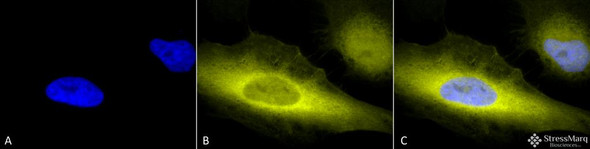
Anti-Cpn10 Antibody
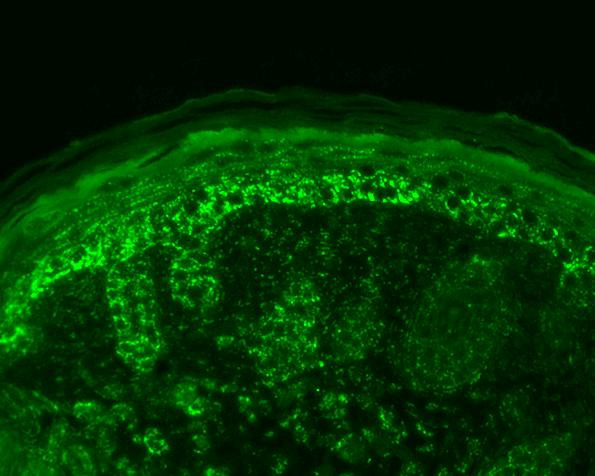
- SKU:
- STPA00036
- Antibody Type:
- Polyclonal
- Applications:
- WB
- Applications:
- IHC
- Applications:
- ICC/IF
- Applications:
- IP
- Applications:
- ELISA
- Reactivity:
- Human
- Reactivity:
- Mouse
- Reactivity:
- Rat
- Reactivity:
- Bovine
- Reactivity:
- Dog
- Reactivity:
- Guinea Pig (Cavia porcellus)
- Reactivity:
- Pig
- Reactivity:
- Rabbit
- Reactivity:
- Sheep
- Reactivity:
- African clawed frog (Xenopus laevis)
- Host Species:
- Rabbit



Description
Cpn10 Antibody
Cpn10 Antibody is a rabbit polyclonal antibody directed against Cpn10, offered by Assay Genie for research applications. Reported applications include WB, IHC, ICC/IF, IP and ELISA. Reported reactivity: Human, Mouse, Rat, Bovine, Dog, Guinea Pig (Cavia porcellus), Pig, Rabbit, Sheep and African clawed frog (Xenopus laevis). Purified by Protein A.
Cpn10 (Chaperonin 10), a member of the HSP10 family, functions as a co-chaperone with HSP60 to facilitate proper protein folding and assembly. It is essential for maintaining proteostasis, particularly under stress conditions such as oxidative damage and inflammation. In the nervous system, Cpn10 supports mitochondrial protein folding and cellular resilience. Its identification as early pregnancy factor and presence in serum suggest systemic regulatory roles, potentially acting as a stress-responsive signaling molecule. Given the central role of protein misfolding in neurodegenerative diseases like Alzheimer’s and Parkinson’s, Cpn10 is a candidate for therapeutic exploration in modulating chaperone networks and preventing proteotoxicity. This antibody is also available conjugated to ATTO 390, ATTO 488, ATTO 594, APC, Biotin, FITC, HRP, PerCP and RPE. Supplied in 100 µg. For research use only; not for diagnostic or therapeutic procedures.
| Product Name: | Cpn10 Antibody |
| Product SKU: | STPA00036 |
| Size: | 100 µg |
| Target: | Cpn10 |
| Host Species: | Rabbit |
| Antibody Type: | Polyclonal |
| Research Areas: | Cancer, Heat Shock, Cell Signaling, Protein Trafficking, Chaperone Proteins, Cell Signaling, Metabolism, Mitochondrial Metabolism, Mitochondrial Markers |
| Buffer: | PBS pH7.3, 0.02% sodium azide |
| Storage & Shipping: | Store at -20°C. Shipped on Blue Ice or 4°C. Conjugated variants should be stored according to the product label. |
| Format: | Liquid |
| Applications: | WB, IHC, ICC/IF, IP, ELISA |
| Purification: | Protein A Purified |
| Concentration: | 1 mg/ml |
| Reactivity: | Human, Mouse, Rat, Bovine, Dog, Guinea Pig (Cavia porcellus), Pig, Rabbit, Sheep, African clawed frog (Xenopus laevis) |
| Recommended Dilution: | WB (1:1000), IHC (1:100); optimal dilutions for assays should be determined by the user. |
| Specificity: | Detects ~ 10kDa. |
| Guarantee: | 12 months from date of dispatch |
| Immunogen: | Human Cpn10 peptide AA 91-101 |
| Immunogen Species: | Human |
| Accession Number: | NP_002148.1 |
| Gene ID: | 3336 |
| Swiss-Prot: | P61604 |
| Cellular Localization: | Mitochondrion | Mitochondrion Matrix |
| Alternative Names: | 10kDa Chaperonin, Chaperonin 10, Cpn 10, EPF, GROES, Heat Shock 10kD protein1, HSP10, HSPE1 |
| References: | 1. Velez-Granell C.S., et al. (1994) J of Cell Science. 107(3): 539-549. 2. Morton H., Hegh V., and Clunie G.J.A. (1974) Nature (London) 249: 459-460. 3. Cavanagh A.C., and Morton H. (1994) Eur. J. Biochem. 222: 551-560. 4. Minto M., et al. (1998) Molecular Cell Research. 1403 (2): 151-157. |
| Note: | For research use only. |
Related Products
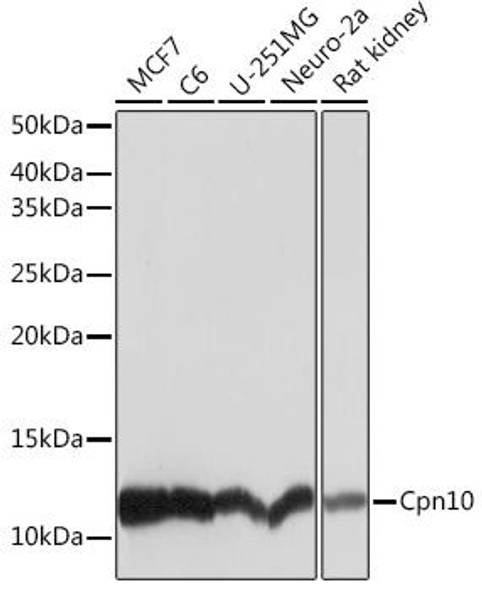
HSPE1/HSP10/CPN10 Rabbit Monoclonal Antibody (CAB5580)
Metabolism Antibodies 3


Anti-HSP110 Antibody


Anti-NHE3 Antibody


Anti-Rab4 Antibody