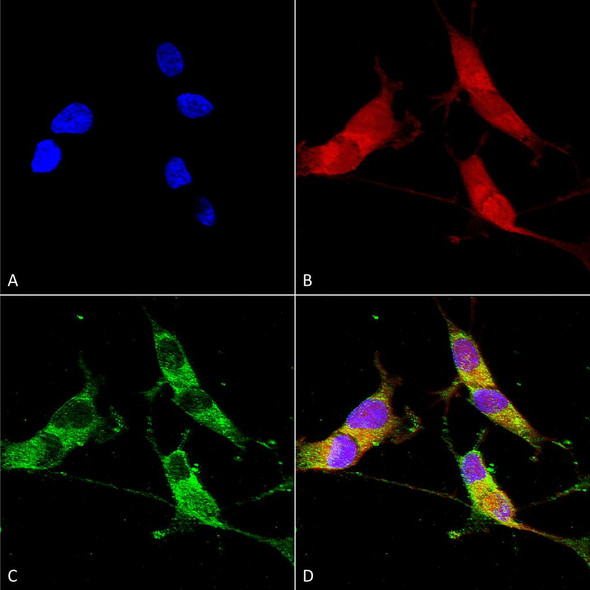
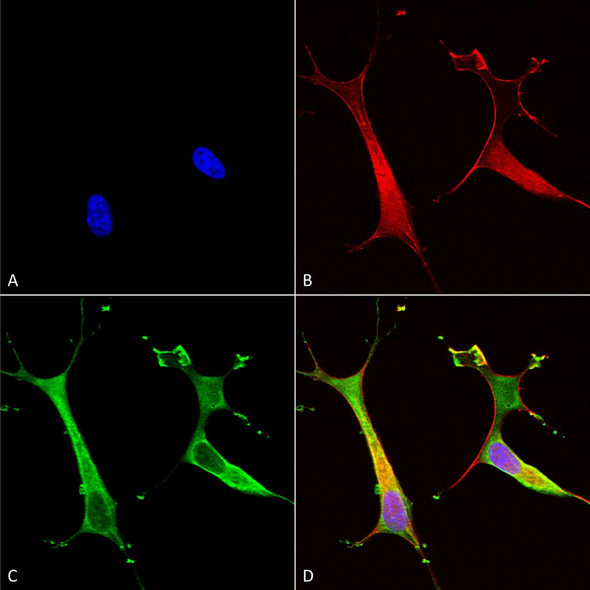
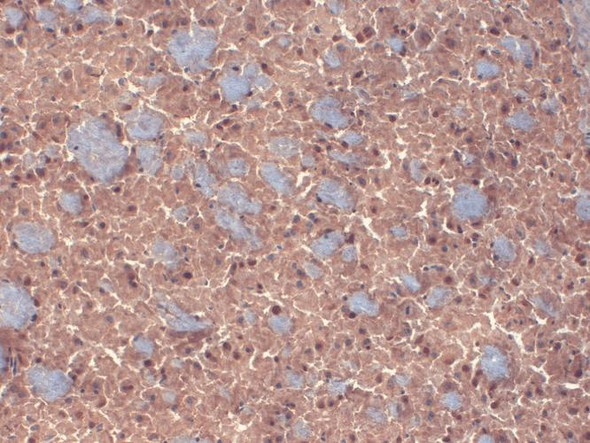
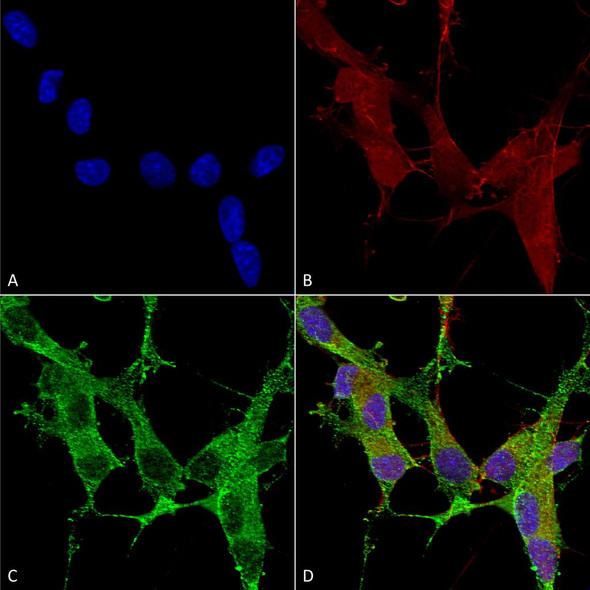
Nav beta 3 Antibody [N396/29 (Formerly sold as S396-29)]
Nav beta 3 Antibody [N396/29 (Formerly sold as S396-29)] is a mouse monoclonal antibody directed against Nav beta 3, offered by Assay Genie for research applications. Reported applications include WB and ICC/IF. Reported reactivity: Human, Mouse and Rat. Supplied as IgG2B, purified by Protein G.
NaVβ3 (encoded by SCN3B) is a regulatory subunit of voltage-gated sodium channels that modulates channel gating kinetics and neuronal excitability. Unlike other β subunits, NaVβ3 slows inactivation and promotes persistent sodium currents, which enhance synaptic input summation and increase neuronal responsiveness. This property may contribute to hyperexcitability in specific neuronal populations, a feature observed in epilepsy and neurodegenerative disorders. NaVβ3 also interacts with neurofascin, facilitating the localization and retention of sodium channels at the nodes of Ranvier in developing and mature myelinated axons. This interaction is essential for saltatory conduction and efficient neural signaling. Disruption of SCN3B has been linked to Brugada syndrome, highlighting its role in excitable tissue function. In the context of neurodegeneration, altered NaVβ3 expression or function may contribute to impaired action potential propagation, synaptic dysfunction, and neuronal vulnerability. Its role in modulating persistent sodium currents suggests a potential link to excitotoxicity and calcium overload, both of which are implicated in diseases such as ALS and Alzheimer’s disease. NaVβ3 thus represents a promising target for understanding and modulating neuronal excitability in neurodegenerative conditions. This antibody is also available conjugated to ATTO 390, ATTO 488, ATTO 594, APC, Biotin, FITC, HRP, PerCP and RPE. Supplied in 100 µg. For research use only; not for diagnostic or therapeutic procedures.
Product Name:
Nav beta 3 Antibody [N396/29 (Formerly sold as S396-29)]
Product SKU:
STMA00169
Size:
100 µg
Target:
Nav beta 3
Host Species:
Mouse
Antibody Type:
Monoclonal
Clone ID:
N396/29 (Formerly sold as S396-29)
Research Areas:
Neuroscience, Ion Channels, Sodium Channels, Voltage-Gated Sodium Channels
Buffer:
PBS pH7.4, 50% glycerol, 0.1% sodium azide
Storage & Shipping:
Store at -20°C. Shipped on Blue Ice or 4°C. Conjugated variants should be stored according to the product label.
Format:
Liquid
Applications:
WB, ICC/IF
Antibody Isotype:
IgG2B
Purification:
Protein G Purified
Concentration:
1 mg/ml
Reactivity:
Human, Mouse, Rat
Recommended Dilution:
WB (1:1000), ICC/IF (1:100); optimal dilutions for assays should be determined by the user.
Specificity:
Detects ~40kDa. Does not cross-reat with NavBeta1, Navbeta2, or Navbeta4.
Guarantee:
12 months from date of dispatch
Immunogen:
Fusion protein amino acids 1-215 (full-length) of rat NavBeta3