
Cell Cycle Recombinant Proteins
Human VRK1 Recombinant Protein (RPES1145)

- SKU:
- RPES1145

Description
Human VRK1 Recombinant Protein
VRK1 is a member of the vaccinia-related kinase (VRK) family of serine/threonine protein kinases. Serine/threonine protein kinases are tumor suppressor that controls the activity of AMP-activated protein kinase family members; thereby playing a role in various processes such as cell metabolism; cell polarity; apoptosis and DNA damage response. VRK1 contains 1 protein kinase domain and localizes to the nucleus. VRK1 gene is widely expressed in human tissues and has increased expression in actively dividing cells; such as those in testis; thymus; fetal liver; and carcinomas. As a serine/threonine kinase; VRK1 phosphorylates 'Thr-18' of p53/TP53 and may thereby prevent the interaction between p53/TP53 and MDM2. Defects in VRK1 are the cause of pontocerebellar hypoplasia type 1 (PCH1); also called pontocerebellar hypoplasia with infantile spinal muscular atrophy or pontocerebellar hypoplasia with anterior horn cell disease. PCH1 is characterized by an abnormally small cerebellum and brainstem; central and peripheral motor dysfunction from birth; gliosis and anterior horn cell degeneration resembling infantile spinal muscular atrophy.
| Product Name: | Human VRK1 Recombinant Protein (RPES1145) |
| Product Code: | RPES1145 |
| Size: | 20µg |
| Species: | Human |
| Expressed Host: | Baculovirus-Insect Cells |
| Synonyms: | PCH1,PCH1A |
| Accession: | Q99986 |
| Sequence: | Met 1-Lys 396 |
| Fusion tag: | N-His & GST |
| Endotoxin: | <1.0 EU per µg as determined by the LAL method. |
| Protein Construction: | A DNA sequence encoding the human VRK1 (Q99986) (Met 1-Lys 396) was fused with the N-terminal polyhistidine-tagged GST tag at the N-terminus. |
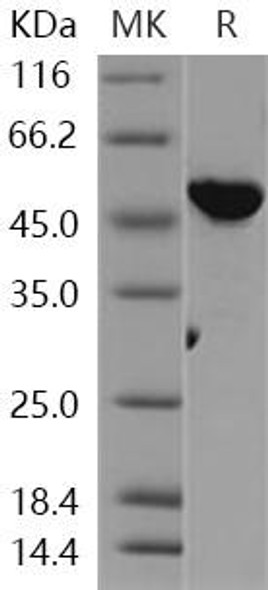
| Purity: | > 88 % as determined by reducing SDS-PAGE. |
| Mol Mass: | 73 kDa |
| AP Mol Mass: | 65-70 kDa |
| Formulation: | Lyophilized from sterile 20mM Tris; 500mM NaCl; pH 7.4; 10% gly |
| Shipping: | This product is provided as lyophilized powder which is shipped with ice packs. |
| Stability and Storage: | Lyophilized proteins are stable for up to 12 months when stored at -20 to -80°C. Reconstituted protein solution can be stored at 4-8°C for 2-7 days. Aliquots of reconstituted samples are stable at < -20°C for 3 months. |
Additional Information
Product Type: |
Recombinant Protein |
Species: |
Human |
Research Area: |
Cell Cycle |
Related Products
Human RNAS2 Recombinant Protein
Human B2M Recombinant Recombinant Protein (RPPB2842)

Human TGFB1 Recombinant Recombinant Protein (RPPB0968)
Growth Factors & Cytokines Recombinant Proteins