
Human IL-1 Receptor Accessory Recombinant Protein/IL-1RAcP/IL-1R3 (C-6His)
(No reviews yet)
Write a Review

- SKU:
- RPES6396

Description
| Product Name: | Human IL-1 Receptor Accessory Recombinant Protein/IL-1RAcP/IL-1R3 (C-6His) |
| Product Code: | RPES6396 |
| Size: | 10µg |
| Species: | Human |
| Expression Host: | HEK293 Cells |
| Synonyms: | Interleukin-1 Receptor Accessory Protein, IL-1 Receptor Accessory Protein, IL-1RAcP, Interleukin-1 Receptor 3, IL-1R-3, IL-1R3, IL1RAP, C3orf13, IL1R3 |
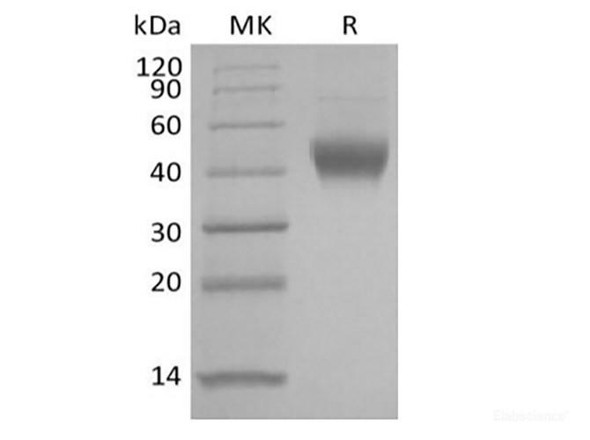
| Mol Mass: | 39.9 kDa |
| AP Mol Mass: | 60 kDa |
| Tag: | C-6His |
| Purity: | > 95 % as determined by reducing SDS-PAGE. |
| Endotoxin Level: | < 1.0 EU per μg of the protein as determined by the LAL method. |
| Bio Activity: | Testing in progress |
| Sequence: | Ser21-Glu359 |
| Accession: | Q9NPH3 |
| Storage: | Generally, lyophilized proteins are stable for up to 12 months when stored at -20 to -80°C. Reconstituted protein solution can be stored at 4-8°C for 2-7 days. Aliquots of reconstituted samples are stable at < -20°C for 3 months. |
| Shipping: | This product is provided as lyophilized powder which is shipped with ice packs. |
| Formulation: | Lyophilized from a 0.2 μm filtered solution of PBS, pH 7.4. Normally 5 % - 8 % trehalose, mannitol and 0.01% Tween80 are added as protectants before lyophilization. Please refer to the specific buffer information in the printed manual. |
| Reconstitution: | Please refer to the printed manual for detailed information. |
| Background: | Interleukin-1 Receptor Accessory Protein (IL-1RAcP) is a member of the interleukin-1 receptor family. It contains three Ig-like C2-type domains in the extracellular region and a long cytoplasmic domain implicated in signal transduction. IL-1RAcP acts as a non-ligand binding accessory component of the receptors for IL1α, IL1βand IL33. IL-1RAcP mediates interleukin-1-dependent activation of NF-kappa-B. It is part of the membrane-bound form of the IL-1 receptor. IL-1 RAcP takes part in the Signaling ways by the formation of a ternary complex containing IL1R1, TOLLIP, MYD88, and IRAK1 or IRAK2. In addition, IL-1RAcP modulates the response to interleukins by associating with soluble IL1R1 and enhancing interleukin-binding to the decoy receptor. |
Related Products

Recombinant Human IL-12 Receptor Subunit Beta1/IL-12RB1/CD212 (C-6His)
OverviewProduct Name:Recombinant Human IL-12 Receptor Subunit Beta1/IL-12RB1/CD212 (C-6His)Product Code:RPES6194Size:10µgSpecies:

Recombinant Mouse IL-1 Receptor-Like 2/IL-1RL2/IL-1Rrp2/IL-36R (C-6His)
OverviewProduct Name:Recombinant Mouse IL-1 Receptor-Like 2/IL-1RL2/IL-1Rrp2/IL-36R (C-6His)Product Code:RPES6639Size:10µgSpecies:
Recombinant Human IL-7 Receptor Subunit alpha/IL-7RA/CD127 (C-6His)
OverviewProduct Name:Recombinant Human IL-7 Receptor Subunit alpha/IL-7RA/CD127 (C-6His)Product Code:RPES6294Size:10µgSpecies:Hu

Recombinant Human IL-3 Receptor Subunit Alpha/IL-3RA/CD123 (C-6His)
OverviewProduct Name:Recombinant Human IL-3 Receptor Subunit Alpha/IL-3RA/CD123 (C-6His)Product Code:RPES6398Size:10µgSpecies:Hum

Human IL-36 Receptor Antagonist Recombinant Protein/IL-36RN/IL-1F5
OverviewProduct Name:Human IL-36 Receptor Antagonist Recombinant Protein/IL-36RN/IL-1F5Product Code:RPES6224Size:10µgSpecies:Huma