
Cell Biology Recombinant Proteins
Human CD155/PVR/NECL5 Recombinant Protein (RPES0460)
(No reviews yet)
Write a Review

- SKU:
- RPES0460

Description
system_update_altDatasheet
Human CD155/PVR/NECL5 Recombinant Protein
Poliovirus Receptor (PVR) is a 70 kDa type I transmembrane single-span glycoprotein that belongs to the nectin-like (Necl) family and was originally identified based on its ability to mediate the cell attachment and entry of poliovirus (PV); an etiologic agent of the central nervous system disease poliomyelitis. PVR contains three Ig-like extracellular domains; a transmembrane segment; and a cytoplasmic tail. The normal cellular function of PVR maybe the involvement of intercellular adhension between epithelial cells. Alternate splicing of the PVR mRNA yields four different isoforms (?; β; ?; and ?) with identical extracellular domains.
| Product Name: | Human CD155/PVR/NECL5 Recombinant Protein (RPES0460) |
| Product Code: | RPES0460 |
| Size: | 10µg |
| Species: | Human |
| Expressed Host: | Human Cells |
| Synonyms: | Poliovirus Receptor, Nectin-Like Protein 5, NECL-5, CD155, PVR, PVS |
| Accession: | P15151 |
| Sequence: | Trp21-Asn343 |
| Fusion tag: | C-Fc |
| Endotoxin: | <1.0 EU per µg as determined by the LAL method. |
| Protein Construction: | Recombinant Human NECL5 is produced by our Mammalian expression system and the target gene encoding Trp21-Asn343 is expressed with a Fc tag at the C-terminus. |
| Purity: | > 95% as determined by reducing SDS-PAGE. |
| Mol Mass: | 62.2 kDa |
| AP Mol Mass: | 80-120 kDa |
| Formulation: | Lyophilized from a 0.2 µm filtered solution of PBS;pH 7.4. |
| Shipping: | This product is provided as lyophilized powder which is shipped with ice packs. |
| Stability and Storage: | Lyophilized proteins are stable for up to 12 months when stored at -20 to -80°C. Reconstituted protein solution can be stored at 4-8°C for 2-7 days. Aliquots of reconstituted samples are stable at < -20°C for 3 months. |
Additional Information
Product Type: |
Recombinant Protein |
Species: |
Human |
Research Area: |
Cell Biology |
Related Products
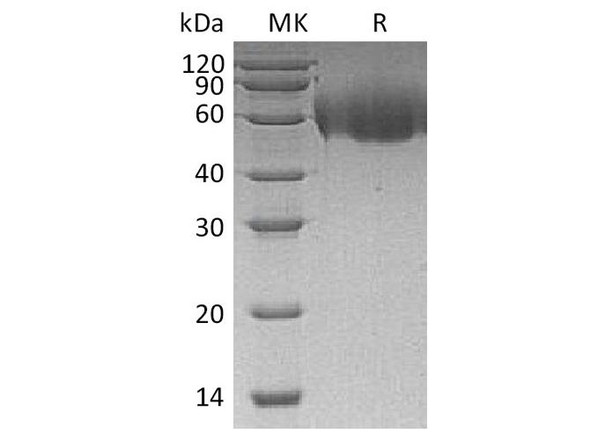
Human CD155/PVR/NECL5 Recombinant Protein (RPES0478)
Cell Biology Recombinant Proteins
system_update_altDatasheetHuman CD155/PVR/NECL5 Recombinant Protein Poliovirus Receptor (PVR) is a 70 kDa type I transmembrane single-span glycoprotein that belongs to the nectin-like (Necl) fami
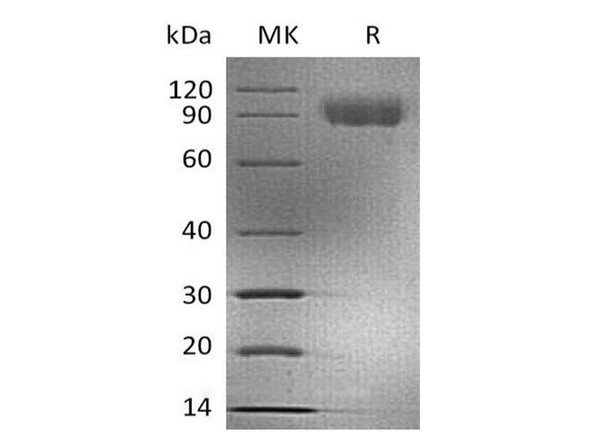
Human CD155/PVR/NECL5 Recombinant Protein (RPES0441)
Cell Biology Recombinant Proteins
system_update_altDatasheetHuman CD155/PVR/NECL5 Recombinant Protein Poliovirus Receptor (PVR) is a 70 kDa type I transmembrane single-span glycoprotein that belongs to the nectin-like (Necl) fami

Human CD155/PVR/NECL5 Recombinant Protein (His tag)
OverviewProduct Name:Human CD155/PVR/NECL5 Recombinant Protein (His tag)Product Code:RPES6072Size:20µgSpecies:Human

Rat CD155/PVR/NECL5 Recombinant Protein (RPES1558)
system_update_altDatasheetRat CD155/PVR/NECL5 Recombinant Protein CD155, commonly known as PVR (poliovirus receptor) and Necl-5 (nectin-like molecule-5), is a type I transmembrane single-span gly

Human CD155/PVR Recombinant Protein (RPES0335)
system_update_altDatasheetHuman CD155/PVR Recombinant Protein CD155; commonly known as PVR (poliovirus receptor) and Necl-5 (nectin-like molecule-5); is a type I transmembrane single-span glycopr