
Cell Death Recombinant Proteins
Beta-amyloid 38/Beta-APP38 Recombinant Protein (RPES1233)

- SKU:
- RPES1233

Description
Beta-amyloid 38/Beta-APP38 Recombinant Protein
Amyloid precursor protein (APP) is a type I transmembrane protein expressed in many tissues and concentrated in the synapses of neurons; and is suggested as a regulator of synapse formation and neural plasticity. APP can be processed by two different proteolytic pathways. In one pathway; APP is cleaved by β- and γ-secretase to produce the amyloid-β-protein (Aβ; Abeta; beta-amyloid) which is the principal component of the amyloid plaques; the major pathological hallmark of Alzheimer’s disease (AD); while in the other pathway; α-secretase is involved in the cleavage of APP whose product exerts antiamyloidogenic effect and prevention of the Aβ peptide formation. The aberrant accumulation of aggregated beta-amyloid peptides (Abeta) as plaques is a hallmark of AD neuropathology and reduction of Abeta has become a leading direction of emerging experimental therapies for the disease. Besides this pathological function of Abeta; recently published data reveal that Abeta also has an essential physiological role in lipid homeostasis. Cholesterol increases Abeta production; and conversely A beta production causes a decrease in cholesterol synthesis. Abeta may be part of a mechanism controlling synaptic activity; acting as a positive regulator presynaptically and a negative regulator postsynaptically. The pathological accumulation of oligomeric Abeta assemblies depresses excitatory transmission at the synaptic level; but also triggers aberrant patterns of neuronal circuit activity and epileptiform discharges at the network level. Abeta-induced dysfunction of inhibitory interneurons likely increases synchrony among excitatory principal cells and contributes to the destabilization of neuronal networks. There is evidence that beta-amyloid can impair blood vessel function. Vascular beta-amyloid deposition; also known as cerebral amyloid angiopathy; is associated with vascular dysfunction in animal and human studies. Alzheimer disease is associated with morphological changes in capillary networks; and soluble beta-amyloid produces abnormal vascular responses to physiological and pharmacological stimuli.
| Product Name: | Beta-amyloid 38/Beta-APP38 Recombinant Protein (RPES1233) |
| Product Code: | RPES1233 |
| Size: | 20µg |
| Species: | Human |
| Expressed Host: | E.coli |
| Synonyms: | AAA,ABETA,ABPP,AD1,APPI,CTFgamma,CVAP,PN-II,PN2 |
| Accession: | P05067-1 |
| Sequence: | Asp672-Gly709 |
| Fusion tag: | N-His & GST |
| Endotoxin: | Please contact us for more information. |
| Protein Construction: | A DNA sequence encoding the amino acids (Asp672-Gly709) of human Amyloid beta A4 protein (APP770) (P05067-1); corresponding to the Beta-amyloid protein 38; was fused with the N-terminal polyhistidine-tagged GST tag at the N-terminus. |
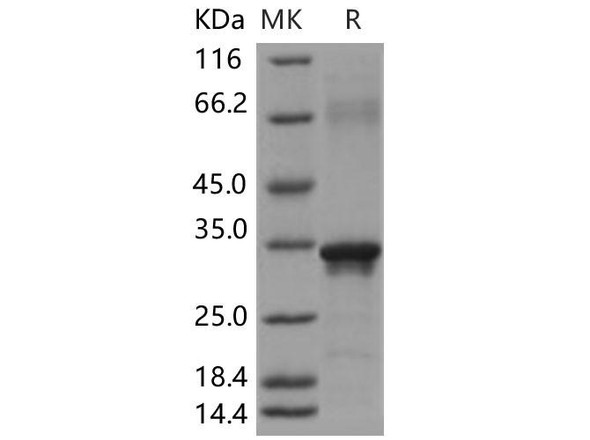
| Purity: | > 85 % as determined by reducing SDS-PAGE. |
| Mol Mass: | 32.1 kDa |
| AP Mol Mass: | 34 kDa |
| Formulation: | Lyophilized from sterile 50 mM Tris; 100 mM NaCl; 20% glycerol; 0.05% Tween 20; pH 9.5. |
| Shipping: | This product is provided as lyophilized powder which is shipped with ice packs. |
| Stability and Storage: | Lyophilized proteins are stable for up to 12 months when stored at -20 to -80°C. Reconstituted protein solution can be stored at 4-8°C for 2-7 days. Aliquots of reconstituted samples are stable at < -20°C for 3 months. |
Additional Information
Product Type: |
Recombinant Protein |
Species: |
Human |
Research Area: |
Cell Death |
Related Products
Beta-amyloid 39/Beta-APP39 Recombinant Protein (RPES3281)
Cell Death Recombinant Proteins

Beta-amyloid 40/Beta-APP40 Recombinant Protein (RPES1270)
Cell Death Recombinant Proteins
Beta-amyloid 42/Beta-APP42 Recombinant Protein (RPES1251)
Cell Death Recombinant Proteins