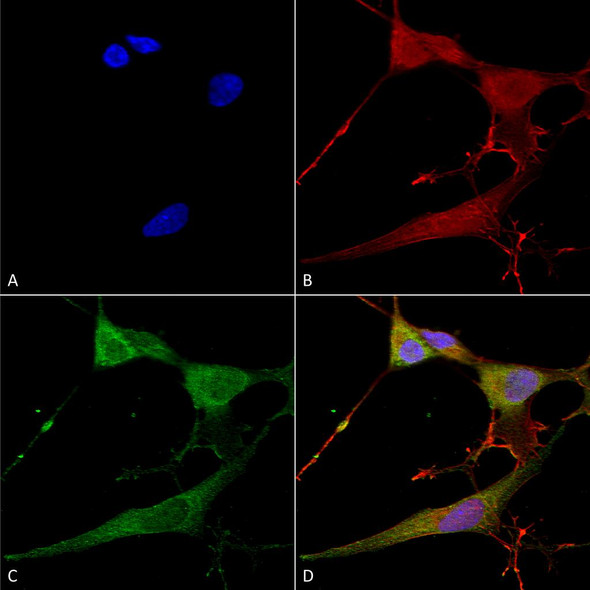
VGLUT3 Antibody [N34/34 (Formerly sold as S34-34)]
VGLUT3 Antibody [N34/34 (Formerly sold as S34-34)] is a mouse monoclonal antibody directed against VGLUT3, offered by Assay Genie for research applications. Reported applications include WB, IHC and ICC/IF. Reported reactivity: Human, Mouse and Rat. Supplied as IgG1, purified by Protein G.
Vesicular Glutamate Transporter 3 (VGLUT3) is a specialized multipass membrane protein localized to synaptic vesicles, where it facilitates the uptake of glutamate—a critical excitatory neurotransmitter—into vesicles for synaptic release. Unlike other VGLUT isoforms, VGLUT3 exhibits a unique and restricted expression pattern, predominantly found in the amygdala, cerebellum, hippocampus, medulla, spinal cord, and thalamus. These brain regions are central to emotion regulation, motor coordination, memory, and sensory processing, all of which are commonly affected in neurodegenerative disorders. VGLUT3 shares approximately 72% sequence homology with VGLUT2 and BNPI, suggesting evolutionary conservation and potential functional overlap, yet it also displays distinct physiological roles. Emerging research implicates VGLUT3 in the pathophysiology of several neurodegenerative diseases, including Parkinson’s disease, Alzheimer’s disease, and epilepsy, due to its involvement in non-canonical glutamatergic signaling and neuromodulation. Understanding VGLUT3’s molecular mechanisms and regional specificity is critical for advancing targeted therapies and biomarker development in neurodegenerative disease research. As a modulator of both excitatory and inhibitory circuits, VGLUT3 represents a promising focal point for neuroscience investigations into synaptic plasticity, neurotransmitter co-release, and circuit dysfunction. This antibody is also available conjugated to ATTO 390, ATTO 488, ATTO 594, APC, Biotin, FITC, HRP, PerCP and RPE. Supplied in 100 µg. For research use only; not for diagnostic or therapeutic procedures.
Product Name:
VGLUT3 Antibody [N34/34 (Formerly sold as S34-34)]