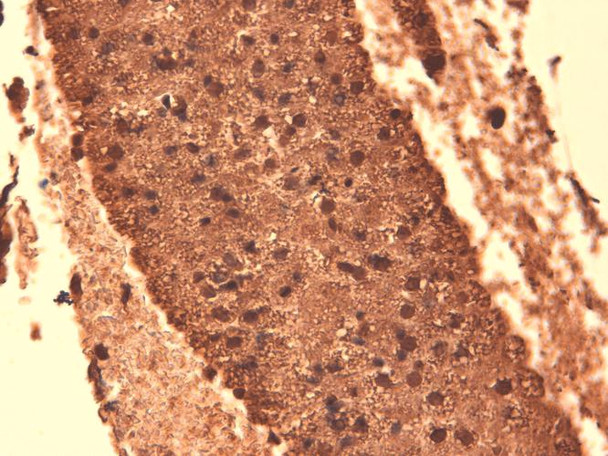
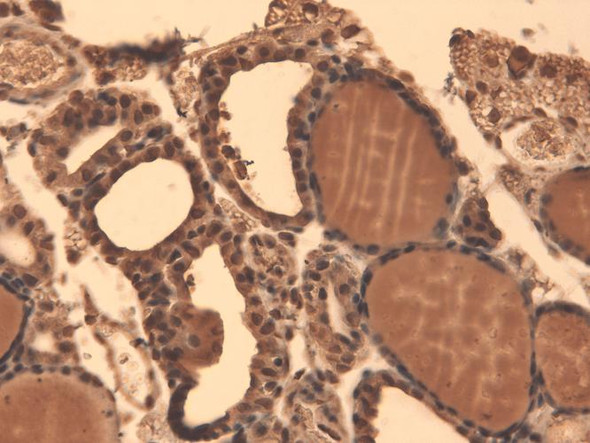
Sodium-Iodide Symporter Antibody [14F] is a mouse monoclonal antibody directed against Sodium-Iodide Symporter, offered by Assay Genie for research applications. Reported applications include WB, IHC and AM. Reported reactivity: Human, Mouse and Rat. Supplied as IgG1, purified by Protein G.
The Sodium Iodide Symporter (NIS), encoded by the SLC5A5 gene, is a transmembrane glycoprotein responsible for actively transporting iodide ions into thyroid epithelial cells. This iodide uptake is a critical first step in the biosynthesis of thyroid hormones—triiodothyronine (T3) and thyroxine (T4)—which are essential regulators of metabolism, development, and neural function. While NIS is traditionally studied in the context of thyroid physiology and thyroid cancer imaging, emerging research highlights its broader relevance in neuroscience. Thyroid hormones play a pivotal role in brain development, synaptic plasticity, and neuroprotection. Dysregulation of NIS-mediated iodide transport can impair thyroid hormone synthesis, potentially contributing to cognitive decline, mood disorders, and neurodegenerative diseases such as Alzheimer’s and Parkinson’s. Recent studies suggest that altered NIS expression or function may influence local thyroid hormone availability in the brain, affecting neuronal energy metabolism and oxidative stress responses. These findings position NIS as a potential biomarker and therapeutic target in neurodegenerative disease research. Understanding the role of NIS in the neuroendocrine axis opens new avenues for exploring how peripheral thyroid dysfunction may drive central nervous system pathology. This antibody is also available conjugated to ATTO 390, ATTO 488, ATTO 594, APC, Biotin, FITC, HRP, PerCP and RPE. Supplied in 100 µg. For research use only; not for diagnostic or therapeutic procedures.
Product Name:
Sodium-Iodide Symporter Antibody [14F]
Product SKU:
STMA00105
Size:
100 µg
Target:
Sodium-Iodide Symporter
Host Species:
Mouse
Antibody Type:
Monoclonal
Clone ID:
14F
Research Areas:
Neuroscience, Pumps/Transporters, Ion Pumps/Transporters, Cell Signaling, Cancer
Buffer:
PBS pH7.4, 50% glycerol, 0.09% sodium azide
Storage & Shipping:
Store at -20°C. Shipped on Blue Ice or 4°C. Conjugated variants should be stored according to the product label.
Format:
Liquid
Applications:
WB, IHC, AM
Antibody Isotype:
IgG1
Purification:
Protein G Purified
Concentration:
1 mg/ml
Reactivity:
Human, Mouse, Rat
Recommended Dilution:
WB (1:1000), IHC (1:1000); optimal dilutions for assays should be determined by the user.
Specificity:
Detects ~97kDa, non-glycosylated version at 68kDa. Other minor bands associated with hNIS at 160kDa, and degradation products at ~30 kDa, and ~15kDa.
Guarantee:
12 months from date of dispatch
Immunogen:
Mannose binding protein hNIS fusion (AA468-643)
Immunogen Species:
Human
Accession Number:
NP_000444.1
Gene ID:
1917-11-14 00:00:00
Swiss-Prot:
Q92911
Cellular Localization:
Membrane
Alternative Names:
NIS, SLC5A5, solute carrier family 5, Na (+)I(-) cotransporter
References:
1. Dai G., Levy O., Carrasco N. (1996) Nature. 379(6564): 458-460. 2. Snabik P.A., et al. (1997) Endocrin. 138(8): 3555-3558. 3. Dohan O., et al. (2007) Proc Natl Acad Sci USA. 104(51): 20250-20255.
Sodium-Iodide Symporter Antibody [FP5]Sodium-Iodide Symporter Antibody [FP5] is a mouse monoclonal antibody directed against Sodium-Iodide Symporter, offered by Assay Genie for research applications...
system_update_altDatasheetHuman Sodium Iodide Symporter (NIS) ELISA KitThe Human Sodium Iodide Symporter (NIS) ELISA Kit is a powerful tool for measuring levels of the NIS pro





![Anti-Sodium Potassium ATPase [R07-1K9] Monoclonal Antibody (AGMB01748)](https://cdn11.bigcommerce.com/s-rd6ounxcu2/images/stencil/590x590/products/113702/127744/anti-sodium-potassium-atpase-r07-1k9-monoclonal-antibody-agmb01748__14389__96667.1786840574.jpg?c=1 "Anti-Sodium Potassium ATPase [R07-1K9] Monoclonal Antibody (AGMB01748)")