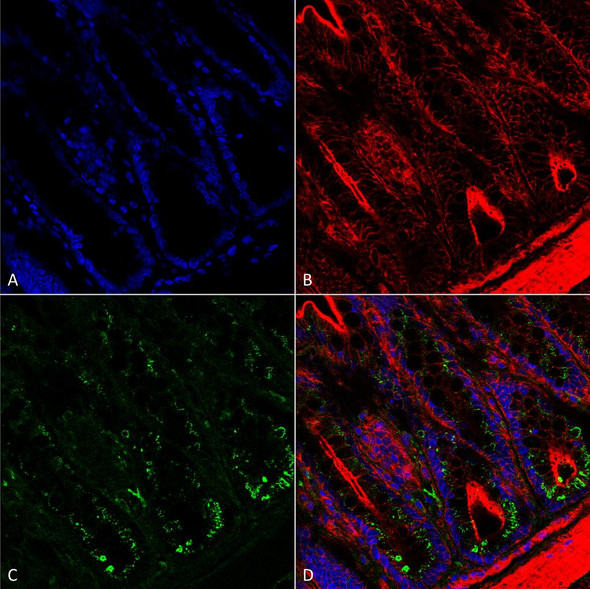
O-GlcNAc Antibody [9H6] is a mouse monoclonal antibody directed against O-GlcNAc, offered by Assay Genie for research applications. Reported applications include WB, ICC/IF, IHC and ELISA. Reactivity is species independent. Supplied as IgM, purified by PEG.
O-GlcNAcylation is a reversible post-translational modification involving the attachment of N-acetylglucosamine (GlcNAc) to serine and threonine residues of nuclear and cytoplasmic proteins. This modification, catalyzed by O-GlcNAc transferase (OGT) and removed by O-GlcNAcase (OGA), plays a critical role in neuronal signaling, transcriptional regulation, and proteostasis. In the central nervous system, O-GlcNAcylation modulates synaptic plasticity, axonal transport, and stress responses. It acts as a nutrient and stress sensor, integrating metabolic status with cellular function. Dysregulation of O-GlcNAc cycling has been implicated in several neurodegenerative diseases, including Alzheimer’s, Parkinson’s, and Huntington’s disease. In Alzheimer’s disease, reduced O-GlcNAcylation correlates with increased tau hyperphosphorylation and aggregation, contributing to neurofibrillary tangle formation. Enhancing O-GlcNAc levels has been shown to reduce tau pathology and improve cognitive function in preclinical models. Similarly, in Parkinson’s disease, O-GlcNAcylation influences α-synuclein aggregation and mitochondrial function. Given its broad regulatory scope and neuroprotective potential, O-GlcNAcylation is emerging as a promising therapeutic target. Pharmacological modulation of OGT and OGA activity is under investigation for restoring proteostasis and mitigating neurodegenerative progression. As a dynamic and responsive signaling mechanism, O-GlcNAcylation bridges metabolism, stress adaptation, and neuronal health—making it a focal point in the search for disease-modifying interventions in neurodegeneration. This antibody is also available conjugated to ATTO 390, ATTO 488, ATTO 594, APC, Biotin, FITC, HRP, PerCP and RPE. Supplied in 100 µg. For research use only; not for diagnostic or therapeutic procedures.
Store at -20°C. Shipped on Blue Ice or 4°C. Conjugated variants should be stored according to the product label.
Format:
Liquid
Applications:
WB, ICC/IF, IHC, ELISA
Antibody Isotype:
IgM
Purification:
PEG Purified
Concentration:
1 mg/ml
Reactivity:
Species Independent
Recommended Dilution:
WB (1:1000); ICC/IF (1:50); ELISA (1:1000); IHC (1:25); optimal dilutions for assays should be determined by the user.
Specificity:
Specific for β-O-Linked N-Acetylglucosamine modified proteins. Does not cross-react with N-Acetylgalactosamine, Glucose, or Galactose modified proteins.
Guarantee:
12 months from date of dispatch
Immunogen:
Synthetic β-O-Linked N-Acetylglucosamine conjugated to Keyhole Limpet Hemocyanin (KLH).


![Anti-FAP [R08-9H6] Monoclonal Antibody (AGMB00908)](https://cdn11.bigcommerce.com/s-rd6ounxcu2/images/stencil/590x590/products/112860/126903/anti-fap-r08-9h6-monoclonal-antibody-agmb00908__11085__74924.1786838416.jpg?c=1 "Anti-FAP [R08-9H6] Monoclonal Antibody (AGMB00908)")
![Anti-IKK beta [R01-9H6] Monoclonal Antibody (AGMB02186)](https://cdn11.bigcommerce.com/s-rd6ounxcu2/images/stencil/590x590/products/114135/128174/anti-ikk-beta-r01-9h6-monoclonal-antibody-agmb02186__56828__66926.1786841675.jpg?c=1 "Anti-IKK beta [R01-9H6] Monoclonal Antibody (AGMB02186)")
![Anti-Myoglobin [R06-9H6] Monoclonal Antibody (AGMB06890)](https://cdn11.bigcommerce.com/s-rd6ounxcu2/images/stencil/590x590/products/118828/132865/anti-myoglobin-r06-9h6-monoclonal-antibody-agmb06890__70307__26010.1786853721.jpg?c=1 "Anti-Myoglobin [R06-9H6] Monoclonal Antibody (AGMB06890)")