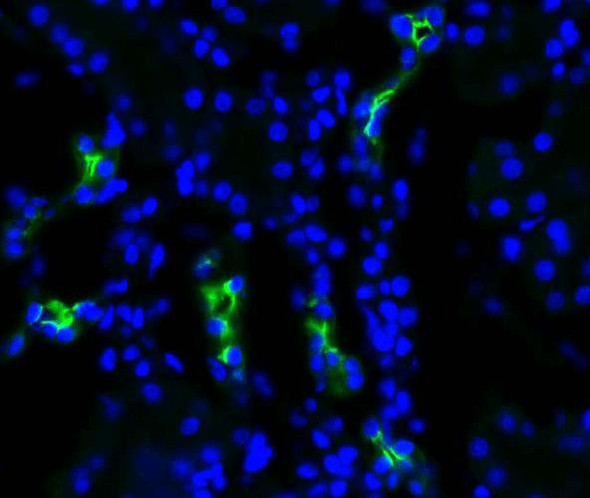
4-Hydroxy-2-hexenal Antibody [6F10] is a mouse monoclonal antibody directed against 4-Hydroxy-2-hexenal, offered by Assay Genie for research applications. Reported applications include WB, ICC/IF, ELISA, FACS and FCM. Reactivity is species independent. Supplied as IgG2b, purified by Protein G.
Lipid peroxidation, driven by oxidative stress, targets carbon-carbon double bonds in polyunsaturated fatty acids (PUFAs), leading to membrane damage and the generation of reactive aldehydes. Among these, 4-Hydroxy-2-hexenal (4-HHE) is a major α,β-unsaturated aldehyde derived specifically from the oxidation of n-3 PUFAs. Emerging evidence highlights 4-HHE as a critical mediator of neuronal injury and a potential biomarker in neurodegenerative disease. 4-HHE is highly electrophilic and forms stable Michael addition adducts with nucleophilic amino acid residues, particularly histidine. These covalent modifications disrupt protein structure and function, impairing key cellular processes such as mitochondrial respiration, synaptic signaling, and proteostasis. Elevated levels of 4-HHE have been observed in various pathological states, including Alzheimer’s disease, Parkinson’s disease, and amyotrophic lateral sclerosis (ALS), implicating it in the progression of oxidative damage and chronic neuroinflammation. In neuroscience research, 4-HHE is gaining attention for its dual role as both a marker of lipid peroxidation and an active contributor to neurotoxicity. Its ability to alter neuronal viability and promote apoptotic pathways underscores its relevance in the study of aging and neurodegeneration. Understanding the molecular mechanisms of 4-HHE toxicity is essential for developing targeted antioxidant therapies and early diagnostic tools in neurodegenerative disease research. This antibody is also available conjugated to ATTO 390, ATTO 488, ATTO 594, APC, Biotin, FITC, HRP, PerCP and RPE. Supplied in 100 µg. For research use only; not for diagnostic or therapeutic procedures.
Product Name:
4-Hydroxy-2-hexenal Antibody [6F10]
Product SKU:
STMA00181
Size:
100 µg
Target:
4-Hydroxy-2-hexenal
Host Species:
Mouse
Antibody Type:
Monoclonal
Clone ID:
6F10
Research Areas:
Cancer, Oxidative Stress, Lipid peroxidation
Buffer:
PBS pH7.4, 50% glycerol, 0.09% sodium azide
Storage & Shipping:
Store at -20°C. Shipped on Blue Ice or 4°C. Conjugated variants should be stored according to the product label.
Format:
Liquid
Applications:
WB, ICC/IF, ELISA, FACS, FCM
Antibody Isotype:
IgG2b
Purification:
Protein G Purified
Concentration:
1 mg/ml
Reactivity:
Species Independent
Recommended Dilution:
WB (1:1000); ICC/IF (1:50); ELISA (1:1000); FACS (1:50); FCM (1:50); optimal dilutions for assays should be determined by the user.
Specificity:
Specific for 4-Hydroxy-2-hexenal (4-HHE) and 4-Hydroxynonenal (4-HNE) modified proteins. Does not detect free 4-Hydroxy-2-hexenal (4-HHE) or 4-Hydroxynonenal (4-HNE). Does not cross-react with Acrolein, Crotonaldehyde, Hexanoyl Lysine, Malondialdehyde, or Methylglyoxal modified proteins.


![Anti-Rubisco (1E3) [1E3-6F10-5H9] Monoclonal Antibody (AGMB04469)](https://cdn11.bigcommerce.com/s-rd6ounxcu2/images/stencil/590x590/products/116416/130452/anti-rubisco-1e3-1e3-6f10-5h9-monoclonal-antibody-agmb04469__09423__97721.1786847534.jpg?c=1 "Anti-Rubisco (1E3) [1E3-6F10-5H9] Monoclonal Antibody (AGMB04469)")
![Anti-c-Myc Tag [7D9-4C6-6F10] Monoclonal Antibody (AGMB06855)](https://cdn11.bigcommerce.com/s-rd6ounxcu2/images/stencil/590x590/products/118795/132830/anti-c-myc-tag-7d9-4c6-6f10-monoclonal-antibody-agmb06855__13197__56322.1786853633.jpg?c=1 "Anti-c-Myc Tag [7D9-4C6-6F10] Monoclonal Antibody (AGMB06855)")