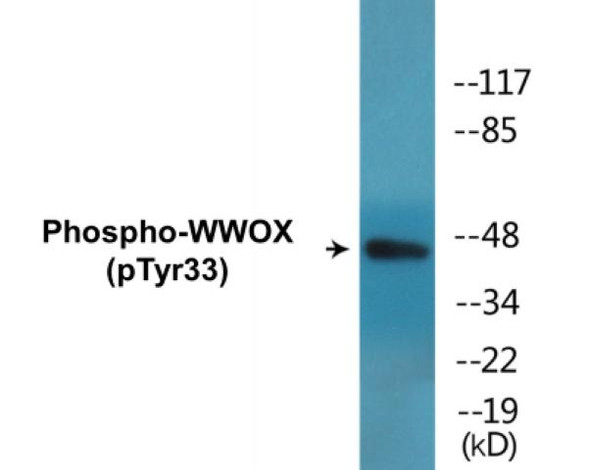
Phospho-WWOX (Tyr33) Antibody (PACO24400)

- SKU:
- PACO24400

Description
| Antibody Name: | Phospho-WWOX (Tyr33) Antibody (PACO24400) |
| Antibody SKU: | PACO24400 |
| Size: | 100ul |
| Host Species: | Rabbit |
| Tested Applications: | ELISA, WB, IHC |
| Recommended Dilutions: | ELISA:1:2000-1:10000, WB:1:500-1:1000, IHC:1:50-1:100 |
| Species Reactivity: | Human, Mouse |
| Immunogen: | Peptide sequence around phosphorylation site of tyrosine 33 (W-V-Y(p)-Y-A) derived from Human WWOX. |
| Form: | Liquid |
| Storage Buffer: | Rabbit IgG in phosphate buffered saline (without Mg2+ and Ca2+), pH 7.4, 150mM NaCl, 0.02% sodium azide and 50% glycerol. |
| Purification Method: | Antibodies were produced by immunizing rabbits with synthetic phosphopeptide and KLH conjugates. Antibodies were purified by affinity-chromatography using epitope-specific phosphopeptide. Non-phospho specific antibodies were removed by chromatogramphy using non-phosphopeptide. |
| Clonality: | Polyclonal |
| Isotype: | IgG |
| Conjugate: | Non-conjugated |
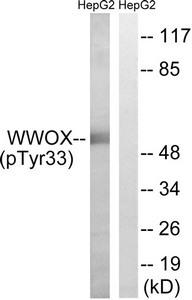 | Western blot analysis of extracts from HepG2 cells treated with PMA using WWOX (Phospho-Tyr33) Antibody.The lane on the right is treated with the antigen-specific peptide. |
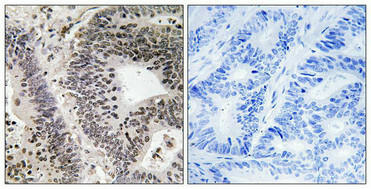 | Immunohistochemical analysis of paraffin-embedded human colon carcinoma tissue using WWOX (Phospho-Tyr33) antibody (left)or the same antibody preincubated with blocking peptide (right). |
| Background: | WW domain-containing proteins are found in all eukaryotes and play an important role in the regulation of a wide variety of cellular functions such as protein degradation, transcription, and RNA splicing. This gene encodes a protein which contains 2 WW domains and a short-chain dehydrogenase/reductase domain (SRD). The highest normal expression of this gene is detected in hormonally regulated tissues such as testis, ovary, and prostate. This expression pattern and the presence of an SRD domain suggest a role for this gene in steroid metabolism. |
| Synonyms: | FOR; WOX1; Aberrant WW domain-containing oxidoreductase; |
| UniProt Protein Function: | WWOX: an enzyme which contains 2 WW domains and a short-chain dehydrogenase/reductase domain (SRD). Expressed at high levels in hormonally regulated tissues such as testis, ovary, and prostate. Its SRD domain suggest a role for this gene in steroid metabolism. Shown to be an essential mediator of tumor necrosis factor-alpha-induced apoptosis in the mouse. May play a similar role in the human. May function as a suppressor of tumor growth. Alternative splicing of this gene generates 7 isoforms. |
| UniProt Protein Details: | Protein type:EC 1.1.1.-; Apoptosis; Oxidoreductase; Tumor suppressor Chromosomal Location of Human Ortholog: 16q23 Cellular Component: cytoplasm; cytosol; Golgi apparatus; microvillus; mitochondrion; nucleus; plasma membrane Molecular Function:coenzyme binding; cofactor binding; enzyme binding; oxidoreductase activity; protein binding; protein dimerization activity Biological Process: negative regulation of Wnt receptor signaling pathway; osteoblast differentiation; positive regulation of transcription from RNA polymerase II promoter; skeletal morphogenesis; steroid metabolic process; Wnt receptor signaling pathway Disease: Epileptic Encephalopathy, Early Infantile, 28 |
| NCBI Summary: | This gene encodes a member of the short-chain dehydrogenases/reductases (SDR) protein family. This gene spans the FRA16D common chromosomal fragile site and appears to function as a tumor suppressor gene. Expression of the encoded protein is able to induce apoptosis, while defects in this gene are associated with multiple types of cancer. Disruption of this gene is also associated with autosomal recessive spinocerebellar ataxia 12. Disruption of a similar gene in mouse results in impaired steroidogenesis, additionally suggesting a metabolic function for the protein. Alternative splicing results in multiple transcript variants. [provided by RefSeq, May 2014] |
| UniProt Code: | Q96KM3 |
| NCBI GenInfo Identifier: | 635172870 |
| NCBI Gene ID: | 51741 |
| NCBI Accession: | NP_001278926.1 |
| UniProt Secondary Accession: | Q96KM3,Q5MYT5, Q96KM3, Q96RF2, Q9BTT8, Q9NPC9, Q9NRF4 Q9NRF5, Q9NRF6, Q9NRK1, Q9NZC5, A8K323, |
| UniProt Related Accession: | Q9NZC7 |
| Molecular Weight: | 23,868 Da |
| NCBI Full Name: | WW domain-containing oxidoreductase isoform 4 |
| NCBI Synonym Full Names: | WW domain containing oxidoreductase |
| NCBI Official Symbol: | WWOX |
| NCBI Official Synonym Symbols: | FOR; WOX1; EIEE28; FRA16D; SCAR12; HHCMA56; PRO0128; SDR41C1; D16S432E |
| NCBI Protein Information: | WW domain-containing oxidoreductase |
| UniProt Protein Name: | WW domain-containing oxidoreductase |
| UniProt Synonym Protein Names: | Fragile site FRA16D oxidoreductase; Short chain dehydrogenase/reductase family 41C member 1 |
| Protein Family: | WW domain-containing oxidoreductase |
| UniProt Gene Name: | WWOX |
| UniProt Entry Name: | WWOX_HUMAN |
| Antibodies | ELISA Kits |
| Phospho-WWOX (Y33) Antibody (PACO05983) | WWOX (Phospho-Tyr33) Colorimetric Cell-Based ELISA Kit |
| Secondary Antibody |
| Anti-HRP Goat Anti-Rabbit IgG (H+L) Antibody (CABS014) |
| Recommended Products |
| Anti-FITC Goat Anti-Rabbit IgG (H+L) Antibody (CABS011) |
| Anti-HRP-conjugated Beta Actin Antibody (CABC028) |
Additional Information
Product Type: |
Antibody |
Reactivity: |
Human |
Reactivity: |
Mouse |
Host Species: |
Rabbit |
Isotype: |
IgG |
Applications: |
ELISA |
Applications: |
WB |
Applications: |
IHC |
Antibody Type: |
Polyclonal Antibody |
Conjugation: |
Unconjugated |
Related Products