
IPPK Antibody (PACO23768)

- SKU:
- PACO23768

Description
| Antibody Name: | IPPK Antibody (PACO23768) |
| Antibody SKU: | PACO23768 |
| Size: | 100ul |
| Host Species: | Rabbit |
| Tested Applications: | ELISA, WB, IHC, IF |
| Recommended Dilutions: | ELISA:1:2000-1:10000, WB:1:500-1:3000, IHC:1:50-1:100, IF:1:100-1:500 |
| Species Reactivity: | Human, Mouse |
| Immunogen: | Synthesized peptide derived from internal of human IPPK. |
| Form: | Liquid |
| Storage Buffer: | Rabbit IgG in phosphate buffered saline (without Mg2+ and Ca2+), pH 7.4, 150mM NaCl, 0.02% sodium azide and 50% glycerol. |
| Purification Method: | The antibody was affinity-purified from rabbit antiserum by affinity-chromatography using epitope-specific immunogen. |
| Clonality: | Polyclonal |
| Isotype: | IgG |
| Conjugate: | Non-conjugated |
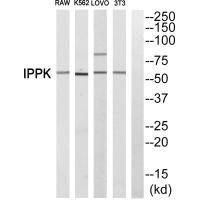 | Western blot analysis of extracts from RAW cells,K562 cells, LOVO cells and 3T3 cells, using IPPK antiobdy. |
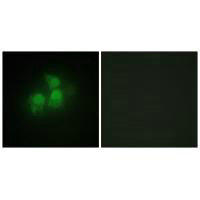 | Immunofluorescence analysis of HepG2 cells, using IPPK antibody. |
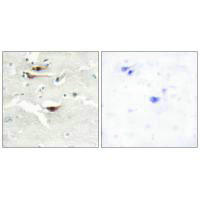 | Immunohistochemistry analysis of paraffin-embedded human brain tissue, using IPPK antibody. |
| Background: | Phosphorylates Ins(1,3,4,5,6)P5 at position 2 to form Ins(1,2,3,4,5,6)P6 (InsP6 or phytate). InsP6 is involved in many processes such as mRNA export, non-homologous end-joining, endocytosis, ion channel regulation. It also protects cells from TNF-alpha-induced apoptosis. |
| Synonyms: | EC 2.7.1.158; Inositol-1; 3; 4; 5 |
| UniProt Protein Function: | IPPK: Phosphorylates Ins(1,3,4,5,6)P5 at position 2 to form Ins(1,2,3,4,5,6)P6 (InsP6 or phytate). InsP6 is involved in many processes such as mRNA export, non-homologous end-joining, endocytosis, ion channel regulation. It also protects cells from TNF-alpha-induced apoptosis. Belongs to the IPK1 type 2 family.Protein type: Motility/polarity/chemotaxis; Carbohydrate Metabolism - inositol phosphate; EC 2.7.1.158; Kinase, otherChromosomal Location of Human Ortholog: 9q22.31Cellular Component: nucleoplasm; intracellular; cytosolMolecular Function: inositol pentakisphosphate 2-kinase activity; ATP bindingBiological Process: inositol phosphate metabolic process |
| UniProt Protein Details: | |
| NCBI Summary: | The protein encoded by this gene is a kinase that phosphorylates position 2 of inositol-1,3,4,5,6-pentakisphosphate to form inositol-1,2,3,4,5,6-hexakisphosphate (InsP6). InsP6 has a variety of functions, including stimulation of DNA repair, endocytosis, and mRNA export. [provided by RefSeq, Nov 2010] |
| UniProt Code: | Q9H8X2 |
| NCBI GenInfo Identifier: | 74752731 |
| NCBI Gene ID: | 64768 |
| NCBI Accession: | Q9H8X2.1 |
| UniProt Secondary Accession: | Q9H8X2,Q5T9F7, Q9H7V8 |
| UniProt Related Accession: | Q9H8X2 |
| Molecular Weight: | |
| NCBI Full Name: | Inositol-pentakisphosphate 2-kinase |
| NCBI Synonym Full Names: | inositol 1,3,4,5,6-pentakisphosphate 2-kinase |
| NCBI Official Symbol: | IPPK |
| NCBI Official Synonym Symbols: | IP5K; IPK1; C9orf12; INSP5K2; bA476B13.1 |
| NCBI Protein Information: | inositol-pentakisphosphate 2-kinase; IPK1 homolog; bA476B13.1 (novel protein); ins(1,3,4,5,6)P5 2-kinase; insP5 2-kinase |
| UniProt Protein Name: | Inositol-pentakisphosphate 2-kinase |
| UniProt Synonym Protein Names: | IPK1 homolog; Inositol-1,3,4,5,6-pentakisphosphate 2-kinase; Ins(1,3,4,5,6)P5 2-kinase; InsP5 2-kinase |
| Protein Family: | |
| UniProt Gene Name: | IPPK |
| UniProt Entry Name: | IPPK_HUMAN |
Additional Information
Product Type: |
Antibody |
Reactivity: |
Human |
Reactivity: |
Mouse |
Host Species: |
Rabbit |
Isotype: |
IgG |
Applications: |
ELISA |
Applications: |
WB |
Applications: |
IHC |
Applications: |
IF |
Antibody Type: |
Polyclonal Antibody |
Conjugation: |
Unconjugated |
Related Products


EPHA10 Antibody
Overview Product Name:EPHA10 AntibodyProduct Code:PACO64693Size:50µLTarget Names:EPHA10Species Reactivity:HumanH

otsB Antibody
Overview Product Name:otsB AntibodyProduct Code:PACO64885Size:50µLTarget Names:otsBSpecies Reactivity:Escherichia coli

PCDHA8 Antibody
Overview Product Name:PCDHA8 AntibodyProduct Code:PACO64893Size:50µLTarget Names:PCDHA8Species Reactivity:HumanH