
Cell Death Recombinant Proteins
Human NGAL/Lipocalin-2 Recombinant Protein (RPES0435)

- SKU:
- RPES0435

Description
Human NGAL/Lipocalin-2 Recombinant Protein
LCN2 is iron-trafficking protein involved in multiple processes such as apoptosis; innate immunity and renal development. LCN2 binds iron through association with 2;5-dihydroxybenzoic acid (2;5-DHBA); a siderophore that shares structural similarities with bacterial enterobactin; and delivers or removes iron from the cell; depending on the context. LCN2 is involved in apoptosis due to interleukin-3 (IL3) deprivation: iron-loaded form increases intracellular iron concentration without promoting apoptosis; while iron-free form decreases intracellular iron levels; inducing expression of the proapoptotic protein BCL2L11/BIM; resulting in apoptosis. LCN2 is involved in innate immunity; possibly by sequestrating iron; leading to limit bacterial growth.
| Product Name: | Human NGAL/Lipocalin-2 Recombinant Protein (RPES0435) |
| Product Code: | RPES0435 |
| Size: | 10µg |
| Species: | Human |
| Expressed Host: | Human Cells |
| Synonyms: | Neutrophil gelatinase-associated lipocalin, NGAL, 25 kDa alpha-2-microglobulin-related subunit of MMP-9, Lipocalin-2, Oncogene 24p3, Siderocalin LCN2, p25, HNL, NGAL |
| Accession: | P80188 |
| Sequence: | Gln21-Gly198 |
| Fusion tag: | C-6His |
| Endotoxin: | <1.0 EU per µg as determined by the LAL method. |
| Protein Construction: | Recombinant Human Neutrophil gelatinase-associated lipocalin is produced by our Mammalian expression system and the target gene encoding Gln21-Gly198 is expressed with a 6His tag at the C-terminus. |
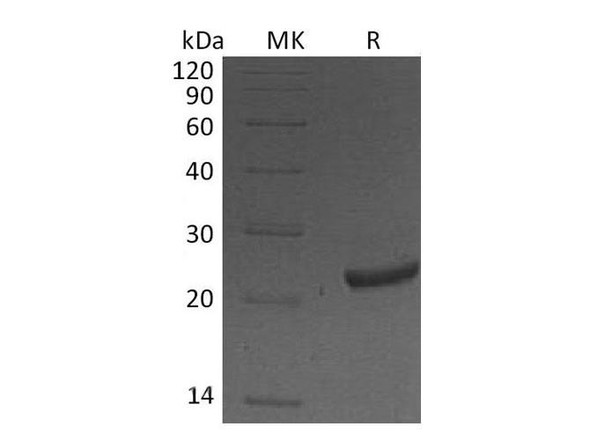
| Purity: | > 95 % as determined by reducing SDS-PAGE. |
| Mol Mass: | 21.6 kDa |
| AP Mol Mass: | 23 kDa |
| Formulation: | Supplied as a 0.2 µm filtered solution of PBS; 50% glycerol;pH7.4. |
| Shipping: | This product is provided as liquid. It is shipped at frozen temperature with blue ice/gel packs.Upon receipt; store it immediately at<-20°C. |
| Stability and Storage: | Store at < -20°C, stable for 6 months. Please minimize freeze-thaw cycles. |
Additional Information
Product Type: |
Recombinant Protein |
Species: |
Human |
Research Area: |
Cell Death |
Related Products

Human NGAL/Lipocalin-2 Recombinant Protein (RPES0454)
Cell Death Recombinant Proteins

Human NGAL/Lipocalin-2 Recombinant Protein (RPES0089)
Mouse NGAL/Lipocalin-2 Recombinant Protein (RPES0706)
Cell Death Recombinant Proteins
Mouse NGAL/Lipocalin-2 Recombinant Protein (RPES1047)
Cell Death Recombinant Proteins
