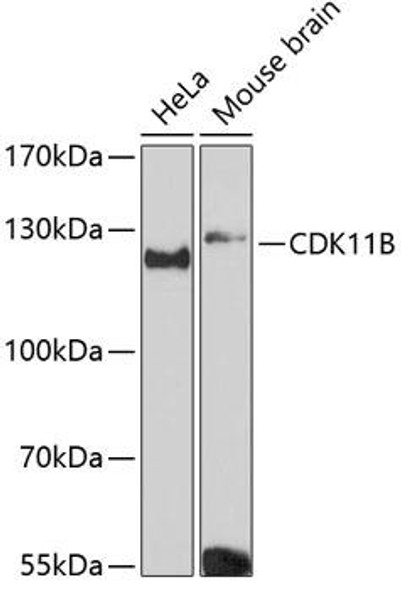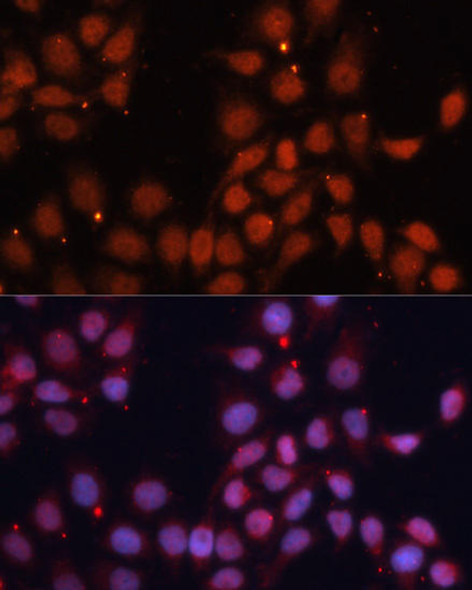
CDK11A/CDK11B Antibody (PACO19445)

- SKU:
- PACO19445

Description
| Antibody Name: | CDK11A/CDK11B Antibody (PACO19445) |
| Antibody SKU: | PACO19445 |
| Size: | 50ul |
| Host Species: | Rabbit |
| Tested Applications: | ELISA, WB, IHC |
| Recommended Dilutions: | ELISA:1:2000-1:5000, WB:1:500-1:2000, IHC:1:50-1:200 |
| Species Reactivity: | Human, Mouse |
| Immunogen: | Synthetic peptide of human CDK11A/CDK11B |
| Form: | Liquid |
| Storage Buffer: | -20°C, pH7.4 PBS, 0.05% NaN3, 40% Glycerol |
| Purification Method: | Antigen affinity purification |
| Clonality: | Polyclonal |
| Isotype: | IgG |
| Conjugate: | Non-conjugated |
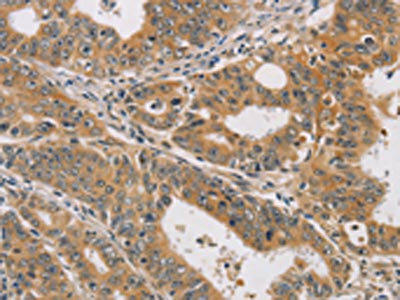 | The image on the left is immunohistochemistry of paraffin-embedded Human gastric cancer tissue using PACO19445(CDK11A/CDK11B Antibody) at dilution 1/40, on the right is treated with synthetic peptide. (Original magnification: x200). |
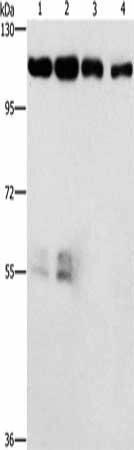 | Gel: 6%SDS-PAGE, Lysate: 40 μg, Lane 1-4: Hela cells, hepG2 cells, lovo cells, human colon cancer tissue, Primary antibody: PACO19445(CDK11A/CDK11B Antibody) at dilution 1/750, Secondary antibody: Goat anti rabbit IgG at 1/8000 dilution, Exposure time: 1 minute. |
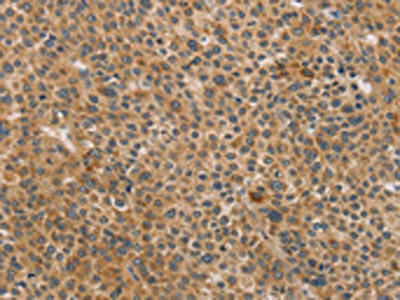 | The image on the left is immunohistochemistry of paraffin-embedded Human liver cancer tissue using PACO19445(CDK11A/CDK11B Antibody) at dilution 1/40, on the right is treated with synthetic peptide. (Original magnification: x200). |
| Background: | Cyclin-dependent kinases (CDKs) are a family of protein kinases first discovered for their role in regulating the cell cycle. They are also involved in regulating transcription, mRNA processing, and the differentiation of nerve cells. They are present in all known eukaryotes, and their regulatory function in the cell cycle has been evolutionarily conserved. CDKs are relatively small proteins, with molecular weights ranging from 34 to 40 kDa, and contain little more than the kinase domain. By definition, a CDK binds a regulatory protein called a cyclin. Without cyclin, CDK has little kinase activity; only the cyclin-CDK complex is an active kinase. CDKs phosphorylate their substrates on serines and threonines, so they are serine-threonine kinases. |
| Synonyms: | cyclin-dependent kinase 11A/B |
| UniProt Protein Function: | CDK11B: a protein kinase of the CDK family. May act as a negative regulator of the normal cell cycle progression. Nine alternatively spliced isoforms have been described. The p110 isoforms have been suggested to be involved in pre-mRNA splicing, potentially by phosphorylating the splicing protein SFRS7. The p58 isoform is specifically induced in G2/M phase of the cell cycle. 2 isoforms, SV9 and 7, are produced by alternative initiation at Met-1 and Met-357 resulting in p110 and p58 isoforms, respectively. Deleted or altered frequently in neuroblastoma with amplified MYCN genes. Can be cleaved by caspases and demonstrated to play a role in cell apoptosis.Protein type: Cell cycle regulation; Protein kinase, Ser/Thr (non-receptor); Kinase, protein; Apoptosis; EC 2.7.11.22; Protein kinase, CMGC; Motility/polarity/chemotaxis; CMGC group; CDK family; PITSLRE subfamily; CDK/PITSLRE subfamilyChromosomal Location of Human Ortholog: 1p36.33Cellular Component: cytoplasm; nucleusMolecular Function: protein serine/threonine kinase activity; protein binding; cyclin-dependent protein kinase activity; ATP binding; protein kinase activityBiological Process: cell proliferation; mitosis; regulation of transcription, DNA-dependent; apoptosis; regulation of cell cycle; regulation of cell growth; protein amino acid phosphorylation; regulation of mRNA processing |
| UniProt Protein Details: | |
| NCBI Summary: | This gene encodes a member of the serine/threonine protein kinase family. Members of this kinase family are known to be essential for eukaryotic cell cycle control. Due to a segmental duplication, this gene shares very high sequence identity with a neighboring gene. These two genes are frequently deleted or altered in neuroblastoma. The protein kinase encoded by this gene can be cleaved by caspases and may play a role in cell apoptosis. Alternative splicing results in multiple transcript variants. [provided by RefSeq, Apr 2014] |
| UniProt Code: | B7ZVY7 |
| NCBI GenInfo Identifier: | 606215171 |
| NCBI Gene ID: | 984 |
| NCBI Accession: | NP_001278274.1 |
| UniProt Secondary Accession: | B7ZVY7,O95265, Q12817, Q12818, Q12819, Q12820, Q12822 Q8N530, B7ZVY7, J3KTL7 |
| UniProt Related Accession: | B7ZVY7,P21127 |
| Molecular Weight: | 49,555 Da |
| NCBI Full Name: | cyclin-dependent kinase 11B isoform 10 |
| NCBI Synonym Full Names: | cyclin dependent kinase 11B |
| NCBI Official Symbol: | CDK11B |
| NCBI Official Synonym Symbols: | p58; PK58; CDK11; CLK-1; CDC2L1; PITSLREA; p58CLK-1; CDK11-p46; CDK11-p58; p58CDC2L1; CDK11-p110 |
| NCBI Protein Information: | cyclin-dependent kinase 11B |
| UniProt Protein Name: | Cyclin-dependent kinase 11B |
| UniProt Synonym Protein Names: | Cell division cycle 2-like protein kinase 1; CLK-1; Cell division protein kinase 11B; Galactosyltransferase-associated protein kinase p58/GTA; PITSLRE serine/threonine-protein kinase CDC2L1; p58 CLK-1 |
| Protein Family: | |
| UniProt Gene Name: | CDK11B |
| UniProt Entry Name: | CD11B_HUMAN |
Additional Information
Product Type: |
Antibody |
Reactivity: |
Human |
Reactivity: |
Mouse |
Host Species: |
Rabbit |
Isotype: |
IgG |
Applications: |
ELISA |
Applications: |
WB |
Applications: |
IHC |
Antibody Type: |
Polyclonal Antibody |
Conjugation: |
Unconjugated |
Related Products