
Cell Biology Antibodies 15
Anti-TACC3 Antibody (CAB18641)
(No reviews yet)
Write a Review

- SKU:
- CAB18641

Description
| Antibody Name: | Anti-TACC3 Antibody |
| Antibody SKU: | CAB18641 |
| Antibody Size: | 20uL, 50uL, 100uL |
| Application: | WB IF |
| Reactivity: | Human |
| Host Species: | Rabbit |
| Immunogen: | Recombinant protein of human TACC3. |
| Application: | WB IF |
| Recommended Dilution: | WB 1:500 - 1:2000 IF 1:50 - 1:200 |
| Reactivity: | Human |
| Positive Samples: |
| Immunogen: | Recombinant protein of human TACC3. |
| Purification Method: | Affinity purification |
| Storage Buffer: | Store at -20°C. Avoid freeze / thaw cycles. Buffer: PBS with 0.02% sodium azide, 50% glycerol, pH7.3. |
| Isotype: | IgG |
| Sequence: | Email for sequence |
| Gene ID: | 10460 |
| Uniprot: | Q9Y6A5 |
| Cellular Location: | |
| Calculated MW: | |
| Observed MW: | Refer to figures |
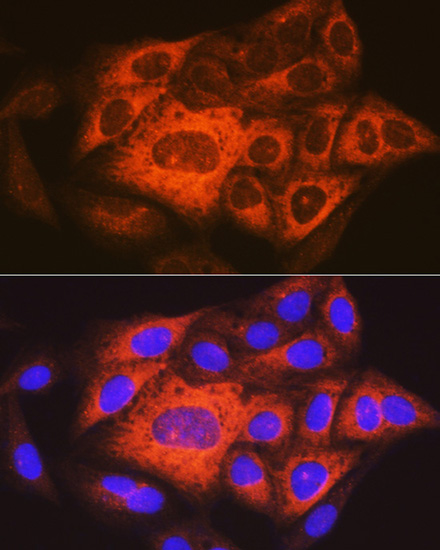 | Immunofluorescence - TACC3 Rabbit pAb (CAB18641) |
| Synonyms: | |
| Background: |
| UniProt Protein Function: | TACC3: Plays a role in the microtubule-dependent coupling of the nucleus and the centrosome. Involved in the processes that regulate centrosome-mediated interkinetic nuclear migration (INM) of neural progenitors. May be involved in the control of cell growth and differentiation. May contribute to cancer. Interacts with microtubules. Interacts with CCDC100/CEP120. The coiled coil C-terminus region interacts with AH receptor nuclear translocator protein (ARNT) and ARNT2. Interacts with GCN5L2 and PCAF. Up-regulated in various cancer cell lines. Belongs to the TACC family. |
| UniProt Protein Details: | Protein type:Cell cycle regulation Chromosomal Location of Human Ortholog: 4p16.3 Cellular Component: centrosome; cytoplasm Molecular Function:protein domain specific binding; protein binding Biological Process: regulation of microtubule-based process; cell proliferation; cytoplasmic sequestering of transcription factor; astral microtubule organization and biogenesis; neurogenesis; regulation of cell cycle; response to hypoxia; hemopoiesis; microtubule cytoskeleton organization and biogenesis; cerebral cortex development; interkinetic nuclear migration Disease: Bladder Cancer |
| NCBI Summary: | The function of this gene has not yet been determined; however, it is speculated that it may be involved in cell growth and differentiation. Expression of this gene is up-regulated in some cancer cell lines, and in embryonic day 15 in mice. [provided by RefSeq] |
| UniProt Code: | Q9Y6A5 |
| NCBI GenInfo Identifier: | 5454102 |
| NCBI Gene ID: | 10460 |
| NCBI Accession: | NP_006333.1 |
| UniProt Related Accession: | Q2NKK4,Q8IX09,Q9Y6A5 |
| Molecular Weight: | 90,522 Da |
| NCBI Full Name: | transforming acidic coiled-coil-containing protein 3 |
| NCBI Synonym Full Names: | transforming, acidic coiled-coil containing protein 3 |
| NCBI Official Symbol: | TACC3 |
| NCBI Official Synonym Symbols: | ERIC1; ERIC-1; MGC117382; MGC133242 |
| NCBI Protein Information: | transforming acidic coiled-coil-containing protein 3; OTTHUMP00000113796 |
| UniProt Protein Name: | Transforming, acidic coiled-coil containing protein 3 |
| Protein Family: | Transforming acidic coiled-coil-containing protein |
| UniProt Gene Name: | TACC3 |
| UniProt Entry Name: | Q2NKK4_HUMAN |
Additional Information
Product Type: |
Antibody |
Reactivity: |
Human |
Host Species: |
Rabbit |
Isotype: |
IgG |
Research Area: |
Cell Biology |
Related Products

Anti-TACC3 Antibody (CAB19617)
OverviewProduct Name:TACC3 Rabbit mAbProduct Code:CAB19617Size:20uL, 50uL, 100uLSynonyms:ERIC-1, ERIC1Applications:

Human anti-EPO antibody(anti-Erythropoietin antibody) ELISA Kit
system_update_altDatasheet - तकनीकी मैनुअलsystem_update_altMSDS - तकनीक


Human Anti-DSG3 antibody(anti-Desmoglein-3 antibody) ELISA Kit
system_update_altDatasheet - तकनीकी मैनुअलsystem_update_altMSDS - तकनीक