


Description
| Antibody Name: | Anti-MET Antibody |
| Antibody SKU: | CAB0040 |
| Antibody Size: | 20uL, 50uL, 100uL |
| Application: | WB |
| Reactivity: | Human, Mouse, Rat |
| Host Species: | Rabbit |
| Immunogen: | Recombinant fusion protein containing a sequence corresponding to amino acids 25-325 of human MET (NP_001120972.1). |
| Application: | WB |
| Recommended Dilution: | WB 1:500 - 1:2000 |
| Reactivity: | Human, Mouse, Rat |
| Positive Samples: | HepG2, Mouse liver, Rat kidney, Rat liver |
| Immunogen: | Recombinant fusion protein containing a sequence corresponding to amino acids 25-325 of human MET (NP_001120972.1). |
| Purification Method: | Affinity purification |
| Storage Buffer: | Store at -20'C. Avoid freeze / thaw cycles. Buffer: PBS with 0.02% sodium azide, 50% glycerol, pH7.3. |
| Isotype: | IgG |
| Sequence: | ECKE ALAK SEMN VNMK YQLP NFTA ETPI QNVI LHEH HIFL GATN YIYV LNEE DLQK VAEY KTGP VLEH PDCF PCQD CSSK ANLS GGVW KDNI NMAL VVDT YYDD QLIS CGSV NRGT CQRH VFPH NHTA DIQS EVHC IFSP QIEE PSQC PDCV VSAL GAKV LSSV KDRF INFF VGNT INSS YFPD HPLH SISV RRLK ETKD GFMF LTDQ SYID VLPE FRDS YPIK YVHA FESN NFIY FLTV QRET LDAQ TFHT RIIR FCSI NSGL HSYM EMPL ECIL TEKR KKRS TKKE VFNI LQAA YVSK P |
| Gene ID: | 4233 |
| Uniprot: | P08581 |
| Cellular Location: | Membrane, Secreted, Single-pass type I membrane protein |
| Calculated MW: | 85kDa/155kDa/157kDa |
| Observed MW: | 155-180kDa |
| Synonyms: | MET, AUTS9, DFNB97, HGFR, RCCP2, c-Met |
| Background: | This gene encodes a member of the receptor tyrosine kinase family of proteins and the product of the proto-oncogene MET. The encoded preproprotein is proteolytically processed to generate alpha and beta subunits that are linked via disulfide bonds to form the mature receptor. Further processing of the beta subunit results in the formation of the M10 peptide, which has been shown to reduce lung fibrosis. Binding of its ligand, hepatocyte growth factor, induces dimerization and activation of the receptor, which plays a role in cellular survival, embryogenesis, and cellular migration and invasion. Mutations in this gene are associated with papillary renal cell carcinoma, hepatocellular carcinoma, and various head and neck cancers. Amplification and overexpression of this gene are also associated with multiple human cancers. |
| UniProt Protein Function: | Receptor tyrosine kinase that transduces signals from the extracellular matrix into the cytoplasm by binding to hepatocyte growth factor/HGF ligand. Regulates many physiological processes including proliferation, scattering, morphogenesis and survival. Ligand binding at the cell surface induces autophosphorylation of MET on its intracellular domain that provides docking sites for downstream signaling molecules. Following activation by ligand, interacts with the PI3-kinase subunit PIK3R1, PLCG1, SRC, GRB2, STAT3 or the adapter GAB1. Recruitment of these downstream effectors by MET leads to the activation of several signaling cascades including the RAS-ERK, PI3 kinase-AKT, or PLCgamma-PKC. The RAS-ERK activation is associated with the morphogenetic effects while PI3K/AKT coordinates prosurvival effects. During embryonic development, MET signaling plays a role in gastrulation, development and migration of muscles and neuronal precursors, angiogenesis and kidney formation. In adults, participates in wound healing as well as organ regeneration and tissue remodeling. Promotes also differentiation and proliferation of hematopoietic cells. May regulate cortical bone osteogenesis. |
| NCBI Summary: | This gene encodes a member of the receptor tyrosine kinase family of proteins and the product of the proto-oncogene MET. The encoded preproprotein is proteolytically processed to generate alpha and beta subunits that are linked via disulfide bonds to form the mature receptor. Further processing of the beta subunit results in the formation of the M10 peptide, which has been shown to reduce lung fibrosis. Binding of its ligand, hepatocyte growth factor, induces dimerization and activation of the receptor, which plays a role in cellular survival, embryogenesis, and cellular migration and invasion. Mutations in this gene are associated with papillary renal cell carcinoma, hepatocellular carcinoma, and various head and neck cancers. Amplification and overexpression of this gene are also associated with multiple human cancers. [provided by RefSeq, May 2016] |
| UniProt Code: | P08581 |
| NCBI GenInfo Identifier: | 251757497 |
| NCBI Gene ID: | 4233 |
| NCBI Accession: | P08581.4 |
| UniProt Secondary Accession: | P08581,O60366, Q12875, Q9UDX7, Q9UPL8, A1L467, B5A932 E7EQ94, |
| UniProt Related Accession: | P08581 |
| Molecular Weight: | 85,745 Da |
| NCBI Full Name: | Hepatocyte growth factor receptor |
| NCBI Synonym Full Names: | MET proto-oncogene, receptor tyrosine kinase |
| NCBI Official Symbol: | MET |
| NCBI Official Synonym Symbols: | HGFR; AUTS9; RCCP2; c-Met; DFNB97 |
| NCBI Protein Information: | hepatocyte growth factor receptor |
| UniProt Protein Name: | Hepatocyte growth factor receptor |
| UniProt Synonym Protein Names: | HGF/SF receptor; Proto-oncogene c-Met; Scatter factor receptor; SF receptor; Tyrosine-protein kinase Met |
| Protein Family: | C-methyltransferase |
| UniProt Gene Name: | MET |
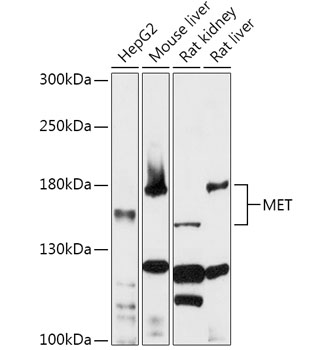 | Western blot analysis of extracts of various cell lines, using MET antibody (CAB0040) at 1:1000 dilution. Secondary antibody: HRP Goat Anti-Rabbit IgG (H+L) (CABS014) at 1:10000 dilution. Lysates/proteins: 25ug per lane. Blocking buffer: 3% nonfat dry milk in TBST. Detection: ECL Basic Kit (RM00020). Exposure time: 3min. |
View AllClose
Additional Information
Product Type: |
Antibody |
Reactivity: |
Human |
Reactivity: |
Mouse |
Reactivity: |
Rat |
Host Species: |
Rabbit |
Isotype: |
IgG |
Antibody Type: |
Polyclonal Antibody |
Research Area: |
Cell Biology |
Related Products


