Metabolism Antibodies 3
Anti-Hsp90 beta Antibody (CAB19574)

- SKU:
- CAB19574

Description
| Antibody Name: | Anti-Hsp90 beta Antibody |
| Antibody SKU: | CAB19574 |
| Antibody Size: | 20uL, 50uL, 100uL |
| Application: | WB IF |
| Reactivity: | Human, Mouse, Rat |
| Host Species: | Rabbit |
| Immunogen: | A synthesized peptide derived from human Hsp90 beta. |
| Application: | WB IF |
| Recommended Dilution: | WB 1:500 - 1:2000 IF 1:50 - 1:200 |
| Reactivity: | Human, Mouse, Rat |
| Positive Samples: | HeLa, A-431, 293T, Mouse kidney, Mouse brain, Mouse liver, Rat heart, Rat testis, Rat liver |
| Immunogen: | A synthesized peptide derived from human Hsp90 beta. |
| Purification Method: | Affinity purification |
| Storage Buffer: | Store at -20°C. Avoid freeze / thaw cycles. Buffer: PBS with 0.02% sodium azide, 0.05% BSA, 50% glycerol, pH7.3. |
| Isotype: | IgG |
| Sequence: | Email for sequence |
| Gene ID: | 3326 |
| Uniprot: | P08238 |
| Cellular Location: | |
| Calculated MW: | 85kDa |
| Observed MW: | 85KDa |
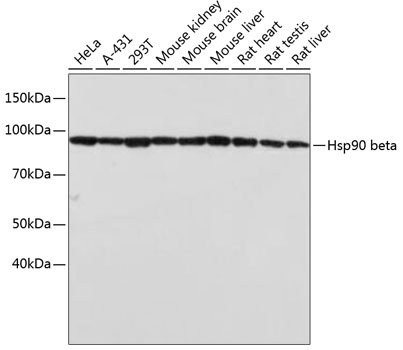 | Western blot - Hsp90 beta Rabbit mAb (CAB19574) |
| Synonyms: | D6S182, HSP84, HSP90B, HSPC2, HSPCB, Hsp90 beta, HSP90AB1 |
| Background: | This gene encodes a member of the heat shock protein 90 family; these proteins are involved in signal transduction, protein folding and degradation and morphological evolution. This gene encodes the constitutive form of the cytosolic 90 kDa heat-shock protein and is thought to play a role in gastric apoptosis and inflammation. Alternative splicing results in multiple transcript variants. Pseudogenes have been identified on multiple chromosomes. [provided by RefSeq, Dec 2012] |
| UniProt Protein Function: | HSP90B: Molecular chaperone that promotes the maturation, structural maintenance and proper regulation of specific target proteins involved for instance in cell cycle control and signal transduction. Undergoes a functional cycle that is linked to its ATPase activity. This cycle probably induces conformational changes in the client proteins, thereby causing their activation. Interacts dynamically with various co-chaperones that modulate its substrate recognition, ATPase cycle and chaperone function. Homodimer. Interacts with p53/TP53. Forms a complex with CDK6 and Hsp90/HSP90AB1. Interacts with UNC45A. Binding to UNC45A involves 2 UNC45A monomers per HSP90AB1 dimer. Interacts with CHORDC1 and DNAJC7. Interacts with FKBP4. Belongs to the heat shock protein 90 family. |
| UniProt Protein Details: | Protein type:Heat shock protein; Chaperone Chromosomal Location of Human Ortholog: 6p12 Cellular Component: apical plasma membrane; basolateral plasma membrane; brush border membrane; cell surface; cytoplasm; cytosol; inclusion body; melanosome; membrane; mitochondrion; nucleoplasm; signalosome Molecular Function:ATP binding; dATP binding; double-stranded RNA binding; GTP binding; histone deacetylase binding; kinase binding; nitric-oxide synthase regulator activity; protein binding; protein kinase binding; sulfonylurea receptor binding; TPR domain binding; unfolded protein binding Biological Process: axon guidance; innate immune response; negative regulation of neuron apoptosis; negative regulation of proteasomal ubiquitin-dependent protein catabolic process; placenta development; positive regulation of cell size; positive regulation of nitric oxide biosynthetic process; positive regulation of protein binding; positive regulation of protein import into nucleus, translocation; protein folding; regulation of protein ubiquitination; response to salt stress; response to unfolded protein; virion attachment to host cell surface receptor |
| NCBI Summary: | This gene encodes a member of the heat shock protein 90 family; these proteins are involved in signal transduction, protein folding and degradation and morphological evolution. This gene encodes the constitutive form of the cytosolic 90 kDa heat-shock protein and is thought to play a role in gastric apoptosis and inflammation. Alternative splicing results in multiple transcript variants. Pseudogenes have been identified on multiple chromosomes. [provided by RefSeq, Dec 2012] |
| UniProt Code: | P08238 |
| NCBI GenInfo Identifier: | 17865718 |
| NCBI Gene ID: | 3326 |
| NCBI Accession: | P08238.4 |
| UniProt Secondary Accession: | P08238,Q5T9W7, Q9NQW0, Q9NTK6, B2R5P0, |
| UniProt Related Accession: | P08238 |
| Molecular Weight: | 83,264 Da |
| NCBI Full Name: | Heat shock protein HSP 90-beta |
| NCBI Synonym Full Names: | heat shock protein 90kDa alpha family class B member 1 |
| NCBI Official Symbol: | HSP90AB1 |
| NCBI Official Synonym Symbols: | HSP84; HSPC2; HSPCB; D6S182; HSP90B |
| NCBI Protein Information: | heat shock protein HSP 90-beta |
| UniProt Protein Name: | Heat shock protein HSP 90-beta |
| UniProt Synonym Protein Names: | Heat shock 84 kDa; HSP 84; HSP84 |
| Protein Family: | Heat shock protein |
| UniProt Gene Name: | HSP90AB1 |
| UniProt Entry Name: | HS90B_HUMAN |
Additional Information
Product Type: |
Antibody |
Reactivity: |
Human |
Reactivity: |
Mouse |
Reactivity: |
Rat |
Host Species: |
Rabbit |
Isotype: |
IgG |
Research Area: |
Metabolism |
Related Products

![Anti-Hsp90 beta Antibody (CAB18015)[KO Validated]](https://cdn11.bigcommerce.com/s-rd6ounxcu2/images/stencil/590x590/products/55160/59903/anti-hsp90-beta-antibody-cab18015ko-validated__02653__79126.1706529182.jpg?c=1 "Anti-Hsp90 beta Antibody (CAB18015)[KO Validated]")