


Description
| Antibody Name: | Anti-FGFR3 Antibody |
| Antibody SKU: | CAB0404 |
| Antibody Size: | 20uL, 50uL, 100uL |
| Application: | WB IHC |
| Reactivity: | Human |
| Host Species: | Rabbit |
| Immunogen: | Recombinant fusion protein containing a sequence corresponding to amino acids 39-138 of human FGFR3 (NP_000133.1). |
| Application: | WB IHC |
| Recommended Dilution: | WB 1:500 - 1:2000 IHC 1:50 - 1:100 |
| Reactivity: | Human |
| Positive Samples: | U-87MG, A-549, A-431 |
| Immunogen: | Recombinant fusion protein containing a sequence corresponding to amino acids 39-138 of human FGFR3 (NP_000133.1). |
| Purification Method: | Affinity purification |
| Storage Buffer: | Store at -20'C. Avoid freeze / thaw cycles. Buffer: PBS with 0.02% sodium azide, 50% glycerol, pH7.3. |
| Isotype: | IgG |
| Sequence: | PGPE PGQQ EQLV FGSG DAVE LSCP PPGG GPMG PTVW VKDG TGLV PSER VLVG PQRL QVLN ASHE DSGA YSCR QRLT QRVL CHFS VRVT DAPS SGDD EDGE |
| Gene ID: | 2261 |
| Uniprot: | P22607 |
| Cellular Location: | Cell membrane, Cytoplasmic vesicle, Endoplasmic reticulum, Secreted, Single-pass type I membrane protein |
| Calculated MW: | 75kDa/85kDa/87kDa/88kDa |
| Observed MW: | 115kDa |
| Synonyms: | ACH, CD333, CEK2, HSFGFR3EX, JTK4, FGFR3 |
| Background: | This gene encodes a member of the fibroblast growth factor receptor (FGFR) family, with its amino acid sequence being highly conserved between members and among divergent species. FGFR family members differ from one another in their ligand affinities and tissue distribution. A full-length representative protein would consist of an extracellular region, composed of three immunoglobulin-like domains, a single hydrophobic membrane-spanning segment and a cytoplasmic tyrosine kinase domain. The extracellular portion of the protein interacts with fibroblast growth factors, setting in motion a cascade of downstream signals, ultimately influencing mitogenesis and differentiation. This particular family member binds acidic and basic fibroblast growth hormone and plays a role in bone development and maintenance. Mutations in this gene lead to craniosynostosis and multiple types of skeletal dysplasia. Three alternatively spliced transcript variants that encode different protein isoforms have been described. |
| UniProt Protein Function: | Tyrosine-protein kinase that acts as cell-surface receptor for fibroblast growth factors and plays an essential role in the regulation of cell proliferation, differentiation and apoptosis. Plays an essential role in the regulation of chondrocyte differentiation, proliferation and apoptosis, and is required for normal skeleton development. Regulates both osteogenesis and postnatal bone mineralization by osteoblasts. Promotes apoptosis in chondrocytes, but can also promote cancer cell proliferation. Required for normal development of the inner ear. Phosphorylates PLCG1, CBL and FRS2. Ligand binding leads to the activation of several signaling cascades. Activation of PLCG1 leads to the production of the cellular signaling molecules diacylglycerol and inositol 1,4,5-trisphosphate. Phosphorylation of FRS2 triggers recruitment of GRB2, GAB1, PIK3R1 and SOS1, and mediates activation of RAS, MAPK1/ERK2, MAPK3/ERK1 and the MAP kinase signaling pathway, as well as of the AKT1 signaling pathway. Plays a role in the regulation of vitamin D metabolism. Mutations that lead to constitutive kinase activation or impair normal FGFR3 maturation, internalization and degradation lead to aberrant signaling. Over-expressed or constitutively activated FGFR3 promotes activation of PTPN11/SHP2, STAT1, STAT5A and STAT5B. Secreted isoform 3 retains its capacity to bind FGF1 and FGF2 and hence may interfere with FGF signaling. |
| NCBI Summary: | This gene encodes a member of the fibroblast growth factor receptor (FGFR) family, with its amino acid sequence being highly conserved between members and among divergent species. FGFR family members differ from one another in their ligand affinities and tissue distribution. A full-length representative protein would consist of an extracellular region, composed of three immunoglobulin-like domains, a single hydrophobic membrane-spanning segment and a cytoplasmic tyrosine kinase domain. The extracellular portion of the protein interacts with fibroblast growth factors, setting in motion a cascade of downstream signals, ultimately influencing mitogenesis and differentiation. This particular family member binds acidic and basic fibroblast growth hormone and plays a role in bone development and maintenance. Mutations in this gene lead to craniosynostosis and multiple types of skeletal dysplasia. [provided by RefSeq, Aug 2017] |
| UniProt Code: | P22607 |
| NCBI GenInfo Identifier: | 120050 |
| NCBI Gene ID: | 2261 |
| NCBI Accession: | P22607.1 |
| UniProt Secondary Accession: | P22607,Q14308, Q16294, Q16608, Q59FL9, D3DVP9, D3DVQ0 |
| UniProt Related Accession: | P22607 |
| Molecular Weight: | 85,083 Da |
| NCBI Full Name: | Fibroblast growth factor receptor 3 |
| NCBI Synonym Full Names: | fibroblast growth factor receptor 3 |
| NCBI Official Symbol: | FGFR3 |
| NCBI Official Synonym Symbols: | ACH; CEK2; JTK4; CD333; HSFGFR3EX |
| NCBI Protein Information: | fibroblast growth factor receptor 3 |
| UniProt Protein Name: | Fibroblast growth factor receptor 3 |
| UniProt Synonym Protein Names: | CD_antigen: CD333 |
| Protein Family: | Fibroblast growth factor receptor |
| UniProt Gene Name: | FGFR3 |
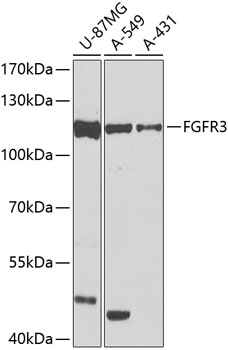 | Western blot analysis of extracts of various cell lines, using FGFR3 antibody (CAB0404) at 1:1000 dilution. Secondary antibody: HRP Goat Anti-Rabbit IgG (H+L) (CABS014) at 1:10000 dilution. Lysates/proteins: 25ug per lane. Blocking buffer: 3% nonfat dry milk in TBST. Detection: ECL Basic Kit (RM00020). Exposure time: 90s. |
View AllClose
Additional Information
Product Type: |
Antibody |
Reactivity: |
Human |
Host Species: |
Rabbit |
Isotype: |
IgG |
Antibody Type: |
Polyclonal Antibody |
Research Area: |
Cell Death |
Related Products


FGFR3 Polyclonal Antibody
FGFR3 Polyclonal AntibodyThe product page for this antibody is being prepared. If you have a question please don't hesitate to get in touch!

Phospho-FGFR3-Y724 Antibody (CABP1274)
OverviewAntibody Name:Phospho-FGFR3-Y724 Antibody (CABP1274)Antibody SKU:CABP1274Antibody Size:50µL, 100µLApplication:Western blottingR

Mouse FGFR3 Recombinant Protein (RPES0487)
system_update_altDatasheetMouse FGFR3 Recombinant Protein FGFR3, also known as CD333, is a member of the fibroblast growth factor receptor (FGFR) family, with its amino acid sequence being highly

Human FGFR3 Recombinant Protein (RPPB2520)
Enzymes Recombinant Proteins
system_update_altDatasheetsystem_update_altMSDS