
ADCY5 Antibody (PACO58681)

- SKU:
- PACO58681

Description
| Antibody Name: | ADCY5 Antibody (PACO58681) |
| Antibody SKU: | PACO58681 |
| Size: | 50ug |
| Host Species: | Rabbit |
| Tested Applications: | ELISA, IF |
| Recommended Dilutions: | ELISA:1:2000-1:10000, IF:1:20-1:200 |
| Species Reactivity: | Human |
| Immunogen: | Recombinant Human Adenylate cyclase type 5 protein (584-719AA) |
| Form: | Liquid |
| Storage Buffer: | Preservative: 0.03% Proclin 300 Constituents: 50% Glycerol, 0.01M PBS, pH 7.4 |
| Purification Method: | >95%, Protein G purified |
| Clonality: | Polyclonal |
| Isotype: | IgG |
| Conjugate: | Non-conjugated |
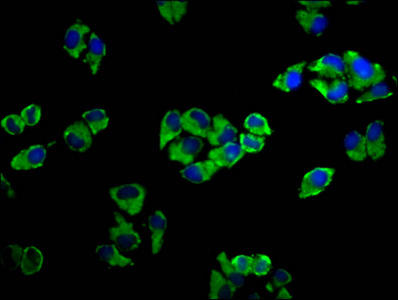 | Immunofluorescence staining of Hela cells with PACO58681 at 1:33, counter-stained with DAPI. The cells were fixed in 4% formaldehyde, permeabilized using 0.2% Triton X-100 and blocked in 10% normal Goat Serum. The cells were then incubated with the antibody overnight at 4°C. The secondary antibody was Alexa Fluor 488-congugated AffiniPure Goat Anti-Rabbit IgG(H+L). |
| Background: | Catalyzes the formation of the signaling molecule cAMP in response to G-protein signaling. Mediates signaling downstream of ADRB1. Regulates the increase of free cytosolic Ca(2+) in response to increased blood glucose levels and contributes to the regulation of Ca(2+)-dependent insulin secretion. |
| Synonyms: | Adenylate cyclase type 5 (EC 4.6.1.1) (ATP pyrophosphate-lyase 5) (Adenylate cyclase type V) (Adenylyl cyclase 5) (AC5), ADCY5 |
| UniProt Protein Function: | ADCY5: This is a membrane-bound, calcium-inhibitable adenylyl cyclase. Belongs to the adenylyl cyclase class-4/guanylyl cyclase family. 2 isoforms of the human protein are produced by alternative splicing.Protein type: Membrane protein, multi-pass; Adenylyl cyclase; Nucleotide Metabolism - purine; Transporter, aquaporin family; EC 4.6.1.1; Transporter; Membrane protein, integral; LyaseChromosomal Location of Human Ortholog: 3q21.1Cellular Component: integral to membrane; plasma membraneMolecular Function: adenylate cyclase activity; adenylate cyclase binding; protein heterodimerization activityBiological Process: activation of protein kinase A; adenylate cyclase activation; cAMP biosynthetic process; cAMP-mediated signaling; elevation of cytosolic calcium ion concentration; G-protein signaling, adenylate cyclase activating pathway; G-protein signaling, adenylate cyclase inhibiting pathway; renal water homeostasisDisease: Dyskinesia, Familial, With Facial Myokymia |
| UniProt Protein Details: | |
| NCBI Summary: | This gene encodes a member of the membrane-bound adenylyl cyclase enzymes. Adenylyl cyclases mediate G protein-coupled receptor signaling through the synthesis of the second messenger cAMP. Activity of the encoded protein is stimulated by the Gs alpha subunit of G protein-coupled receptors and is inhibited by protein kinase A, calcium and Gi alpha subunits. Single nucleotide polymorphisms in this gene may be associated with low birth weight and type 2 diabetes. Alternatively spliced transcript variants that encode different isoforms have been observed for this gene. [provided by RefSeq, Dec 2010] |
| UniProt Code: | O95622 |
| NCBI GenInfo Identifier: | 118572619 |
| NCBI Gene ID: | 111 |
| NCBI Accession: | O95622.3 |
| UniProt Secondary Accession: | O95622,Q7RTV7, Q8NFM3, B7Z8A6 |
| UniProt Related Accession: | O95622 |
| Molecular Weight: | 102,606 Da |
| NCBI Full Name: | Adenylate cyclase type 5 |
| NCBI Synonym Full Names: | adenylate cyclase 5 |
| NCBI Official Symbol: | ADCY5 |
| NCBI Official Synonym Symbols: | AC5; FDFM |
| NCBI Protein Information: | adenylate cyclase type 5 |
| UniProt Protein Name: | Adenylate cyclase type 5 |
| UniProt Synonym Protein Names: | ATP pyrophosphate-lyase 5; Adenylate cyclase type V; Adenylyl cyclase 5; AC5 |
| Protein Family: | Adenylate cyclase |
| UniProt Gene Name: | ADCY5 |
| UniProt Entry Name: | ADCY5_HUMAN |
Additional Information
Product Type: |
Antibody |
Reactivity: |
Human |
Host Species: |
Rabbit |
Isotype: |
IgG |
Applications: |
ELISA |
Applications: |
IF |
Antibody Type: |
Polyclonal Antibody |
Conjugation: |
Unconjugated |


